


range repair specialists
Every burner lit.
We’ll bring
the repair.
Hands-on help for the range your cooking depends on.
Tell us what the burners or the oven did. We’ll sort out the fix.
- Burners, igniters and elements
- Oven heat and temperature
- Gas, electric, dual-fuel, induction
What to expect
Experienced technicians
More than 12 years in appliance repair
Upfront pricing
The cost of the repair in writing, before any work begins
OEM parts on order
Original manufacturer parts ordered against your model number, never third-party substitutes
Warranty on our workmanship
Every repair is backed by a warranty on the work we performed
Your next step
to a working range.
A few details now.
A little less to worry about.
Describe the trouble
Pick the appliance and say what the burners, elements or oven are doing.
Set a day
Pick a date, then an arrival window that works around your week.
Where to come
Enter the address and a number we can ring before the technician sets out.
The make and model number sit on a rating label, most often on the frame behind the storage drawer or along the edge of the oven door opening. They tell us which range we are coming to fix.
or call (844) 875-7576
Loading appointment form…
The appointment form couldn’t load. Please try again.
Four steps,
and no surprises.
The three steps in the form are how you book. These four are what actually happens once a technician is standing in your kitchen.
Every burner and the oven, tried
The technician lights or switches on each burner or element, runs the oven through bake and broil, and watches the flame, the glow or the reading before naming the part that has failed.
A price before any part goes in
You hear which repair the range needs and what it will cost before the work starts. If replacing the range makes more sense, you are told that too.
Common parts on board
Igniters, surface elements, bake elements and oven sensors travel in the van. A control board, a glass top or a part made for one model only is ordered by number, so giving it at booking can save a return trip.
Fixed, then run hot
After the part is fitted, the burners are lit again and the oven is brought up to heat while the technician checks the flame, the temperature and the controls, rather than taking the fix on trust.
Not every range
breaks the same way.
A gas range lights its burners with a spark, an electric one heats coils or elements under a smooth glass top, a dual-fuel range pairs gas burners with an electric oven, and an induction range heats the pan itself through a magnetic field. Find the one in your kitchen.
All range types
Gas range
Open flames on top and a gas-fired oven below, all fed by one supply line behind the range and lit by igniters rather than a match.

Electric range
Coil elements or radiant elements under a smooth glass top, with an electric oven below, all running on a dedicated 240-volt circuit.

Dual-fuel range
Gas burners on top and an electric oven below, the combination most professional-style ranges use, needing both a gas line and a 240-volt circuit.
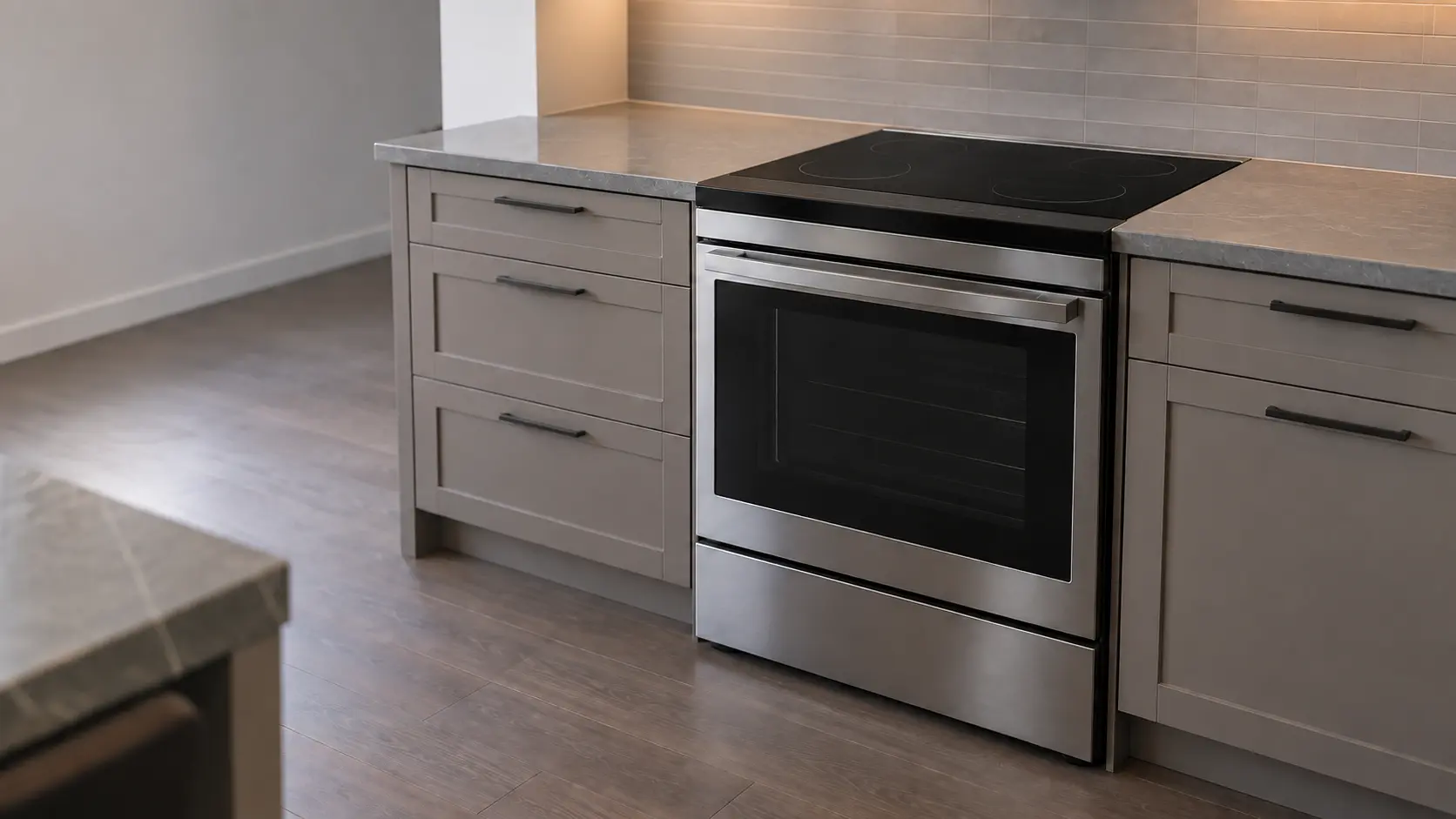
Induction range
A glass top that heats the pan itself through copper coils and power boards, over an electric oven, with electronics doing almost all the work.
Every kind we serviceAll ranges, side by side
The archive puts the 4 types against each other: how to tell which you own, what fails on each, and which manufacturers build them.
How to tell yoursWhat fails on eachWho makes them Open the type archiveBurners that catch on the first click.
An oven that bakes to the setting.
From a burner that clicks and never catches to an element that stays dark or an oven below that will not reach temperature, begin with what the range did at the last meal you cooked on it. Each page says what that usually means before it mentions booking.
 All 17 problems
Range Gas Smell
A sulfur or rotten-egg odor hangs around the range, near the burners on top, low by the oven, or with every knob in the off position.
Range Burning Smell
Smoke, a hot plastic odor or a sharp electrical smell comes from the range top, from the oven below, or from the back of the range.
Range Burner Won't Turn Off
A gas burner keeps its flame, or an electric element or induction zone keeps heating, after its knob or key is set to off.
Range Glass Top Cracked
The smooth glass surface of an electric or induction range has a crack, a chip at the edge, or a break running across a cooking zone.
Range Keeps Tripping the Breaker
The range breaker trips when you switch on an element, the oven or self-clean, or it trips by itself with the range idle.
Range Burner Won't Light
A gas burner on the range top clicks but never catches, lights only after a long delay, or does nothing at all when the knob is turned.
Familiar brands. Expert care.
For the brands
in your kitchen.
Independent repair service. Not affiliated with, authorized or endorsed by any manufacturer. Brand names and model numbers are the property of their respective owners and are used here for identification only, to describe the appliances we service.
What a repair
usually costs.
A useful way to weigh a range repair is to price the new range you would actually buy, not the cheapest one on the floor. A freestanding range is easier to swap than a built-in appliance, but a slide-in or pro-style model has to match the counter gap, the gas or electrical hookup and often the backsplash, and a new one can bring a gas fitter or an electrician along with it. That is why most igniter, element, sensor and hinge repairs are worth doing, and why replacement usually wins only when a board is no longer made, the glass top and a board fail together on an older range, or rust has reached the oven body.
| Repair | Relative cost | Notes |
|---|---|---|
| Gas burner igniter, spark switch or burner head | low | Cleaning ports and reseating a cap costs almost nothing in parts. A new igniter, spark switch or burner head is a small part, and the spark module that feeds them all sits a little higher. |
| Surface element, switch or glass top | low to moderate | A coil, a receptacle or an infinite switch stays near the bottom. A radiant element under the glass is modest, while a whole new glass top is the part that carries this job toward the middle. |
| Bake or broil element | low | The most frequent part on an electric range oven. A hidden bake element under the floor panel adds some time, and scorched terminals behind the rear wall are replaced in the same visit. |
| Gas oven igniter, safety valve or burner | low to moderate | A weak igniter is the usual answer and sits at the low end. A safety valve or a broil burner costs more, and every opened gas joint is leak-tested before the job is closed. |
| Oven temperature sensor, thermostat or calibration | low | An offset adjustment needs no part. A replacement sensor is inexpensive; a capillary thermostat on a pro-style range takes longer to route and sits slightly higher. |
| Induction power board, coil or cooling fan | moderate to highest | A cooling fan or a pan sensor stays in the middle. A power board, or a board and a coil together on a premium induction range, is one of the costliest repairs a range takes. |
| Door hinges, gasket, glass or lock | low | A gasket or a pair of hinges is a short job. Door glass means taking the door apart, and a self-clean lock motor with its switches sits at the upper edge of this band. |
| Knobs, keypad or control board | moderate | A knob or a spark switch is minor. A keypad or ribbon cable lands in the middle, and a main control board, especially one that also runs the zones on top, is the priciest part in this row. |
| Convection fan, blade or ring element | low to moderate | A loose blade or a ring element stays near the low end. A motor reached only by sliding a heavy range out of its opening moves the job toward the middle of the scale. |
9 metros,
one appliance.
Where a range lives decides a lot about how it ages: whether the street has natural gas or the house runs on propane, how old the circuit feeding the kitchen is, how tightly the range is fitted between cabinets. These notes are about ranges in each place, not about the place itself.
All service areasTampa BayFL · 31 areas
Tampa Bay cooks mostly on electric ranges, coil and glass-top, with gas found where a neighborhood has a utility line or a house has a propane tank. Humidity lasts most of the year, summer storms bring outages and surges that reach range controls, and near the water salt air adds corrosion to knobs, hinges and element terminals.
OrlandoFL · 30 areas
Much of Orlando was built recently and by plan, which means one range model tends to repeat along a street, wearing out in the same ways at about the same age. Vacation homes and short-term rentals put glass-top and gas ranges in front of unfamiliar hands, where cracked glass, lost knobs and spills into burner switches are common.
Miami / South FloridaFL · 47 areas
South Florida kitchens are mostly in towers, where the range is electric, usually a glass-top or induction slide-in, and repairs happen in place under building rules. Gas ranges appear in houses on a utility line or a propane tank, and everywhere salt air, humidity and summer storm outages reach knobs, igniters and control boards.
New York MetroNY · 75 areas
Gas has fed New York kitchens for generations, and most apartments still cook on a gas range, often a narrow one in a galley kitchen. Buildings set the hours for any work, a smell of gas brings in the utility and often the building, and the newest construction is going all-electric, carrying induction ranges into kitchens that never had them.
HoustonTX · 36 areas
Houston is one of the metros here where many houses cook on gas, so a range may be gas, electric or a dual-fuel model that uses both. Storm outages matter to every kind: an electric range goes dark, and many gas range ovens cannot light without power, while long humid summers work on the controls.
ChicagoIL · 50 areas
Across Chicagoland gas is the usual way houses and older apartments cook, so most ranges are gas, from vintage models to pro-style ones in remodels, while glass-top and induction ranges are more common in high-rises and new construction. Older piping and wiring are real factors, and the winter holidays bring the heaviest cooking of the year.
Los AngelesCA · 95 areas
Los Angeles kitchens run the whole history of the range, from mid-century gas models still in service to pro-style dual-fuel ranges in new remodels, with induction appearing in rebuilt and newly built homes. Gas reaches most houses, and coastal neighborhoods add corrosion to the list while inland ones mostly show the wear of daily cooking.
San DiegoCA · 31 areas
A gentle climate spares most San Diego ranges, though homes close to the beach see salt on spark electrodes, knobs and door hinges. Many established houses cook on gas, and in the inland master-planned neighborhoods bigger kitchens make room for wider dual-fuel ranges, while a beach cottage usually manages with a 30-inch model.
San Francisco Bay AreaCA · 74 areas
The Bay Area holds both ends of the change in how kitchens cook: older houses on gas, with ranges that have served for years, and remodels and new buildings that choose induction as local rules favor all-electric construction. Designed remodels bring pro-style and European ranges, and damp air near the water reaches burners and controls in the flats closest to it.

Answers before
you book.
How soon can a technician see my range?
Do you fix my make of range?
What should I have ready for the visit?
What does a range repair cost?
Is it worth repairing a range rather than replacing it?
One burner will not light but the others work. Is that dangerous?
Work out what
you are dealing with.
Split by what you are trying to find out rather than by what part of the appliance it concerns.
All 18 guides


Curious what a range repair runs to? That has its own page rather than a line here, because no one can give a fair number before a technician has had the range out and opened it — range repair cost.
Back to your everyday
Let’s get your range working again.
Three short steps, a window that suits you, and a price for the actual repair before any work starts.