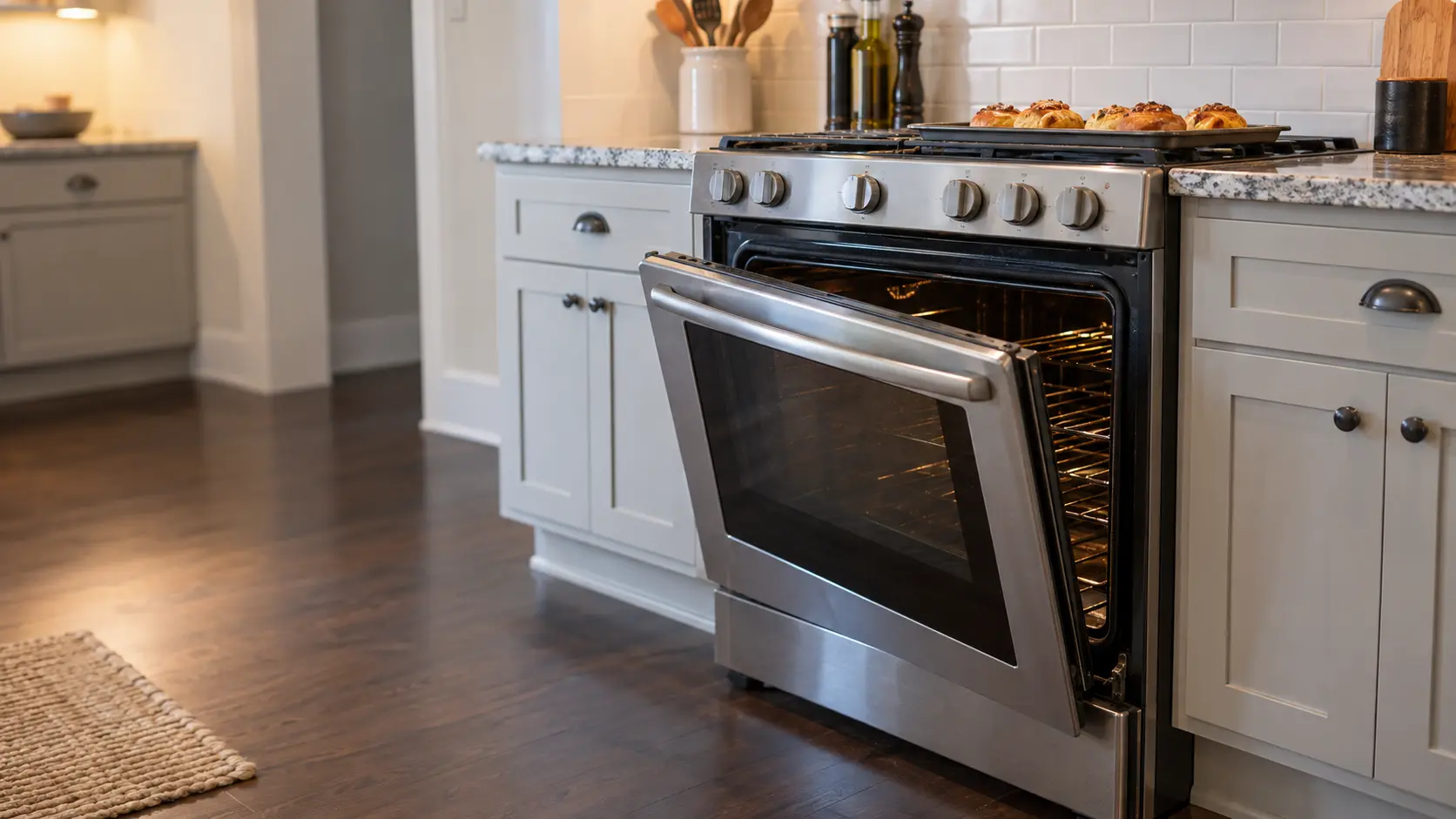
Why the cleaning heat reaches the whole range
A cleaning cycle burns baked-on soil down to a pale ash. GE puts the cavity at a maximum of 885°F and the cycle at roughly 90 minutes to four hours, depending on how heavy the soil is, with a smoke eliminator turning most of the fumes into an almost odorless vapor. On a wall-mounted oven that heat is boxed into cabinetry; on a range it sits directly under the cooking surface and directly above the drawer, with the controls in between.
That is the reason owners of a self-cleaning range have a longer checklist than they expect. What sits on the range top, what is stored beneath the oven and what is left in the cavity all feel the heat.
The range top during a clean
Glass tops, backguards and the area around the oven vent grow hot while the cycle runs. GE's range manuals list the range top, the oven vent opening and the trim above the door among surfaces that get hot, and warn against leaving plastic items on top, where they can melt. Clear the whole surface before starting, not just the burners you use.
The drawer below the oven
Some ranges have a plain storage drawer under the oven, others an electric warming drawer. GE notes that its warming drawer cannot be used during a self-clean cycle. A storage drawer holding plastic containers, silicone mats or paper towels is worth emptying for the day, since it sits right under the hottest part of the range.
Source: GE Appliances — Wall oven or range: benefit of the self-clean cycle — The cavity heats to a maximum of 885°F, the cycle lasts one and a half to four hours, and a smoke eliminator converts soil to an essentially odorless vapor
Clearing the range, top to bottom
Go through the range in order, from the top down. The whole list takes a few minutes, and each item on it is either something the heat can ruin or something that can mark the range itself.
- Range top: pans, utensils, spoon rests and anything plastic, including knob covers and cutting boards left resting on the glass.
- Burner parts: grates, caps and drip pans stay on the range top or in the sink, never inside the oven for the cycle.
- Cavity: the broiler pan, cookware, temperature probes, silicone mats and every piece of aluminum foil or oven liner.
- Racks: out, unless the manual identifies them as self-clean racks; GE's dark enameled self-clean racks can stay, and shiny chrome ones should come out.
- Drawer: switch off a warming drawer, and empty a storage drawer of anything that can melt or scorch.
Source: GE Appliances — Range and wall oven: tips for self clean — Remove probes, foil, silicone mats and stored pans; remove racks unless they are dark enameled self-clean racks; GE Appliances — Self-cleaning gas range owner's manual and installation instructions (49-80036) — Do not leave plastic items on the range top; the warming drawer cannot be used during self-clean; grates and drip pans must not be cleaned in a self-cleaning oven; no oven cleaners or protectors; vent the kitchen; move birds to another well-ventilated room

Preparing the oven cavity
The range must be completely cool before a cycle can be set. Wipe up loose spills and pooled grease from the oven floor with a damp cloth, because liquid soil makes heavy smoke rather than ash. If you use soap for that, rinse it away, since GE says soap left behind can stain during the cycle.
No oven cleaner in a self-cleaning oven
Commercial oven cleaners and oven protector coatings do not belong in or near a self-cleaning oven. GE's manuals explain that the combination of their residue and the cycle's temperatures can damage the porcelain finish, so a spray bottle used 'to give the cycle a head start' ends up costing a liner.
Leave the door gasket alone
Clean the door liner outside the woven gasket, but do not rub, wet or move the gasket itself; GE describes its material as having very low resistance to abrasion. Make sure the oven light cover is in place and the light is switched off before the door locks.
Source: GE Appliances — Self-cleaning radiant range use and care guide (49-8723) — Rinse soap before cleaning; do not rub the gasket; the insulation gives off a very small amount of carbon monoxide, minimized by ventilation; never force the latch; white spots are salt residue; oil the rack supports
Fresh air, pet birds and the locked door
GE recommends venting the kitchen with an open window or an exhaust fan during at least the first cleaning cycles, and its radiant range guide notes that the insulation in a self-clean oven gives off a very small amount of carbon monoxide during the cycle, which ventilation keeps low. A slight odor during the first few cleans is normal.
Birds are the household members most at risk. GE's manuals state that some birds are extremely sensitive to the fumes given off during the cleaning cycle of any oven and should be moved to another well-ventilated room, well away from the kitchen, before the cycle starts.
The door locks for the duration and stays locked until the cavity has cooled below its locking temperature. On older ranges with a manual latch, GE warns never to force the handle, because that damages the lock mechanism; wait for the signal that it is free.
While the cycle runs, a few habits keep the afternoon uneventful:
- Stay home for the whole cycle rather than setting it to run while the house is empty.
- Keep children away from the front of the range, since the door glass and the trim above it get hot.
- Leave the exhaust fan running until the cycle ends and the smell has cleared.
- Do not try to open the door or cancel and restart the cycle to hurry it along.
Source: GE Appliances — Self-cleaning gas range owner's manual and installation instructions (49-80036) — Do not leave plastic items on the range top; the warming drawer cannot be used during self-clean; grates and drip pans must not be cleaned in a self-cleaning oven; no oven cleaners or protectors; vent the kitchen; move birds to another well-ventilated room; GE Appliances — Self-cleaning radiant range use and care guide (49-8723) — Rinse soap before cleaning; do not rub the gasket; the insulation gives off a very small amount of carbon monoxide, minimized by ventilation; never force the latch; white spots are salt residue; oil the rack supports
Afterward, and how often a range can take it
Once the door unlocks and the oven is cool, wipe out the ash with a damp cloth. White spots that stay behind are usually a salt residue the cycle cannot burn off, which GE suggests removing and then rinsing with a vinegar and water mix. Chrome racks that went through the cycle turn gray and may stick; a little cooking oil on the rack supports helps them slide again.
GE says most owners self-clean their ranges two or three times a year, and that while it sets no firm limit, cycles more often than about once a month could shorten a range's life through wear on components and controls. Between cycles, wiping spills while they are fresh keeps each cleaning shorter and less smoky.
Steam clean as a lighter option
Some ranges also offer a Steam Clean mode for light soil. On GE and Profile models that have it, the method is to pour a cup of water onto the cool oven floor, run the program, then soak up the water and wipe the loosened soil. It is no substitute for a full cycle on heavy grease, but it spares the range the heat for everyday spatters.
Source: GE Appliances — Range and wall oven: self clean oven frequency of use — Most owners self-clean their ranges two or three times a year; more than about once a month could shorten the range's life; GE Appliances — Self-cleaning radiant range use and care guide (49-8723) — Rinse soap before cleaning; do not rub the gasket; the insulation gives off a very small amount of carbon monoxide, minimized by ventilation; never force the latch; white spots are salt residue; oil the rack supports