
Why a dirty burner stops lighting well
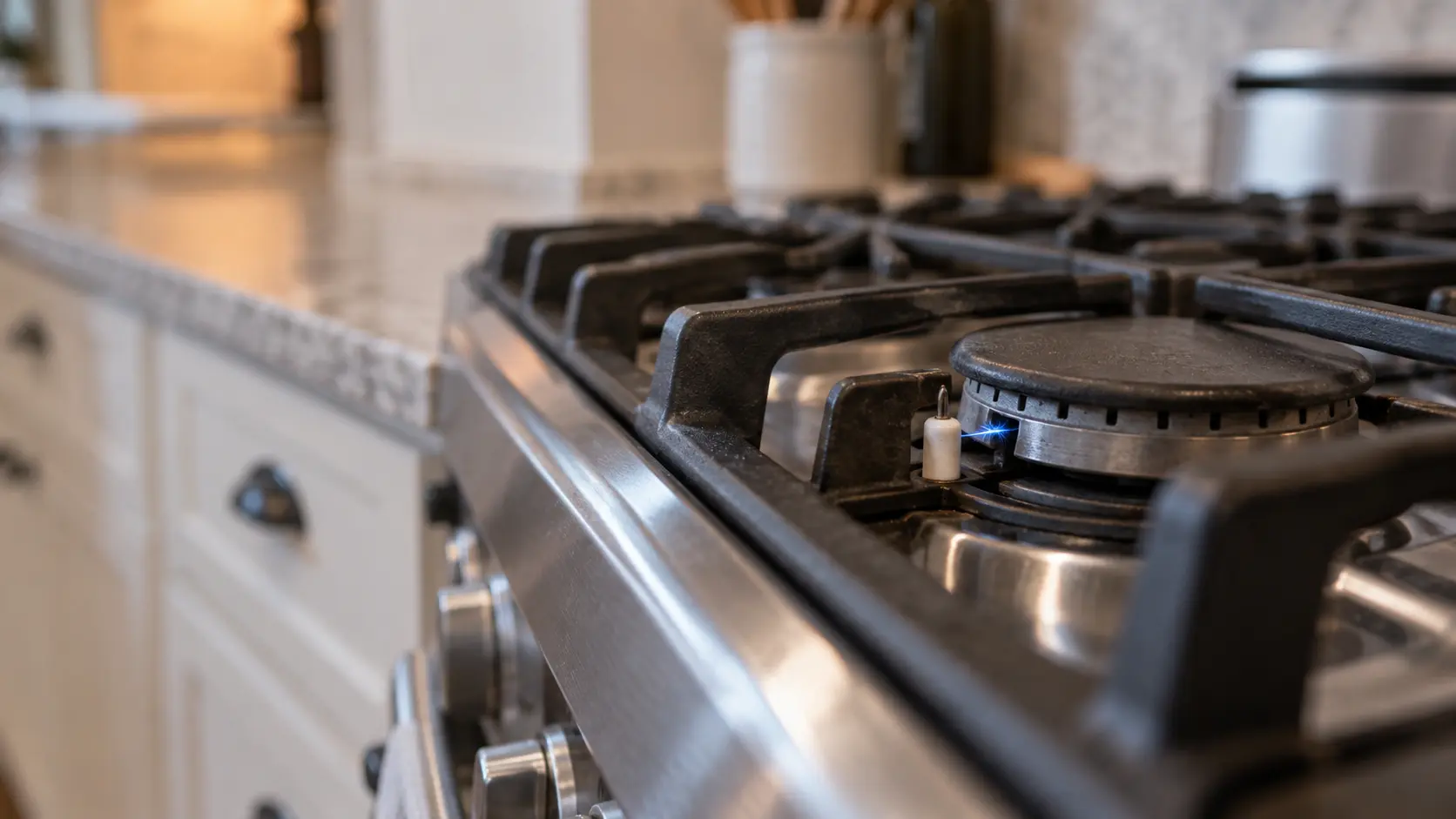
Gas leaves a burner through a ring of small ports or slits, and the spark that lights it jumps from an electrode to the edge of the burner head. Sauce, starch and grease that boil over run straight into both. Partly blocked ports give a flame that is ragged, lifts off the head or burns with yellow tips, and a coated electrode or blocked ignition port leaves the burner clicking without catching.
GE's gas range manual puts it plainly: the openings must be kept clean at all times for proper ignition and an even flame, and burners should be cleaned routinely, especially after a bad spillover. The best time to clean gas range burners is therefore the evening of the boil-over, before the residue has been cooked hard by the next meal.
- Grate: the cast-iron or enameled support the pan sits on.
- Burner cap: the flat disc on top that spreads the flame outward.
- Burner head: the slotted ring under the cap, where the flame ports are cut.
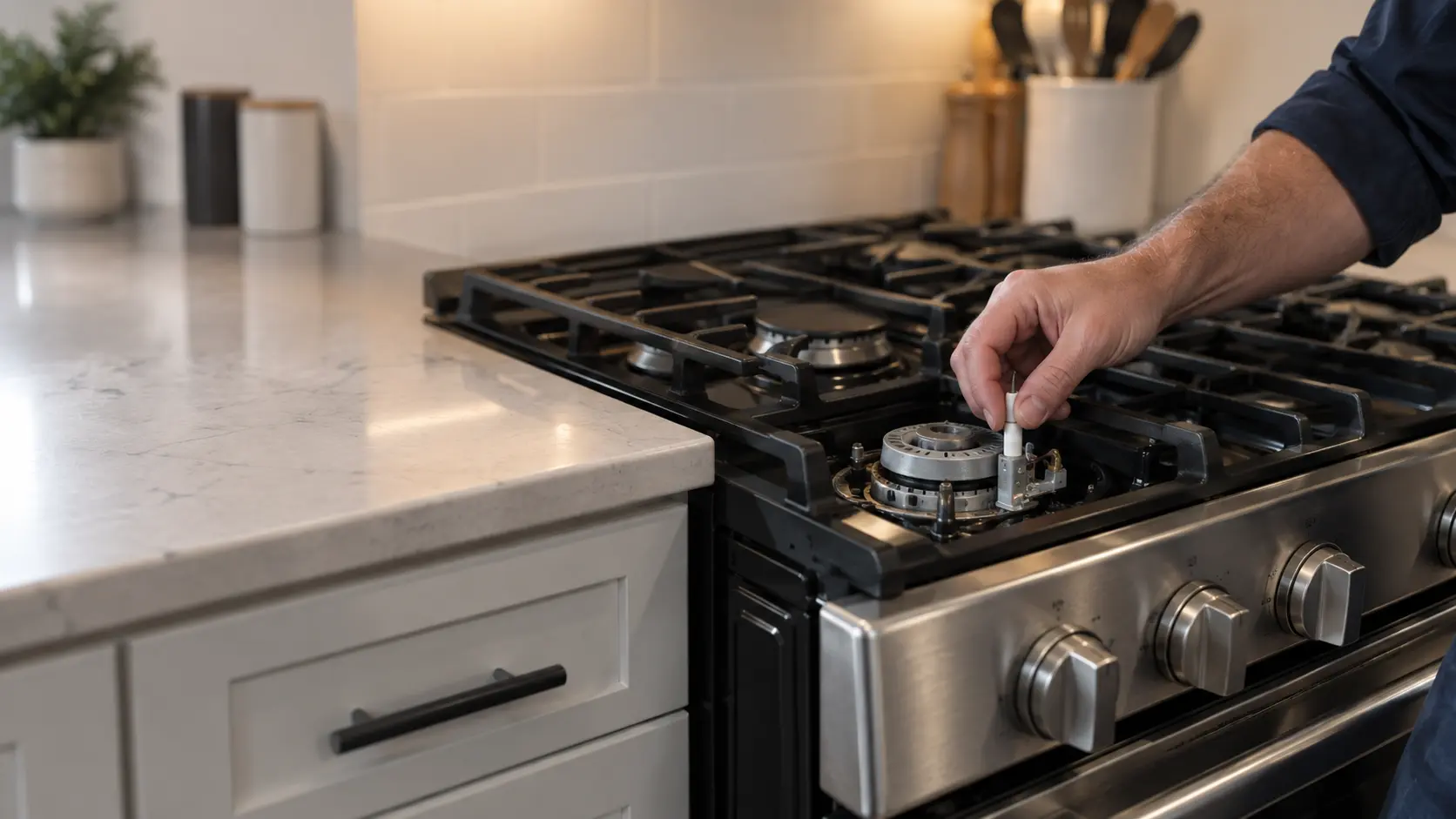
- Electrode: the small ceramic-and-metal post beside the head that sparks when the knob is turned.
Source: GE Appliances — Self-cleaning gas range owner's manual and installation instructions (49-80036) — Burner openings must be kept clean for ignition and an even flame; all burners spark when one is at Lite; soak heads 20–30 minutes; clear ports with a sewing needle or twist-tie; dry heads 30 minutes in a warm oven; no dishwasher or self-clean for grates; oil cast-iron undersides; air openings are needed for combustion
Before anything comes off the range top
Every knob must be at Off and every part cool enough to hold. GE's manual adds a warning that surprises many owners: when one burner is turned to Lite, all the burners spark, so nobody should be cleaning around one burner while another is in use. The exposed electrode can deliver a shock sharp enough to make you knock over a hot pan.
Note which cap and head came from which position. Most ranges mix sizes, for example one small, two medium and one large, and each cap and head has to return to the burner it fits.
Sealed burners and older open burners
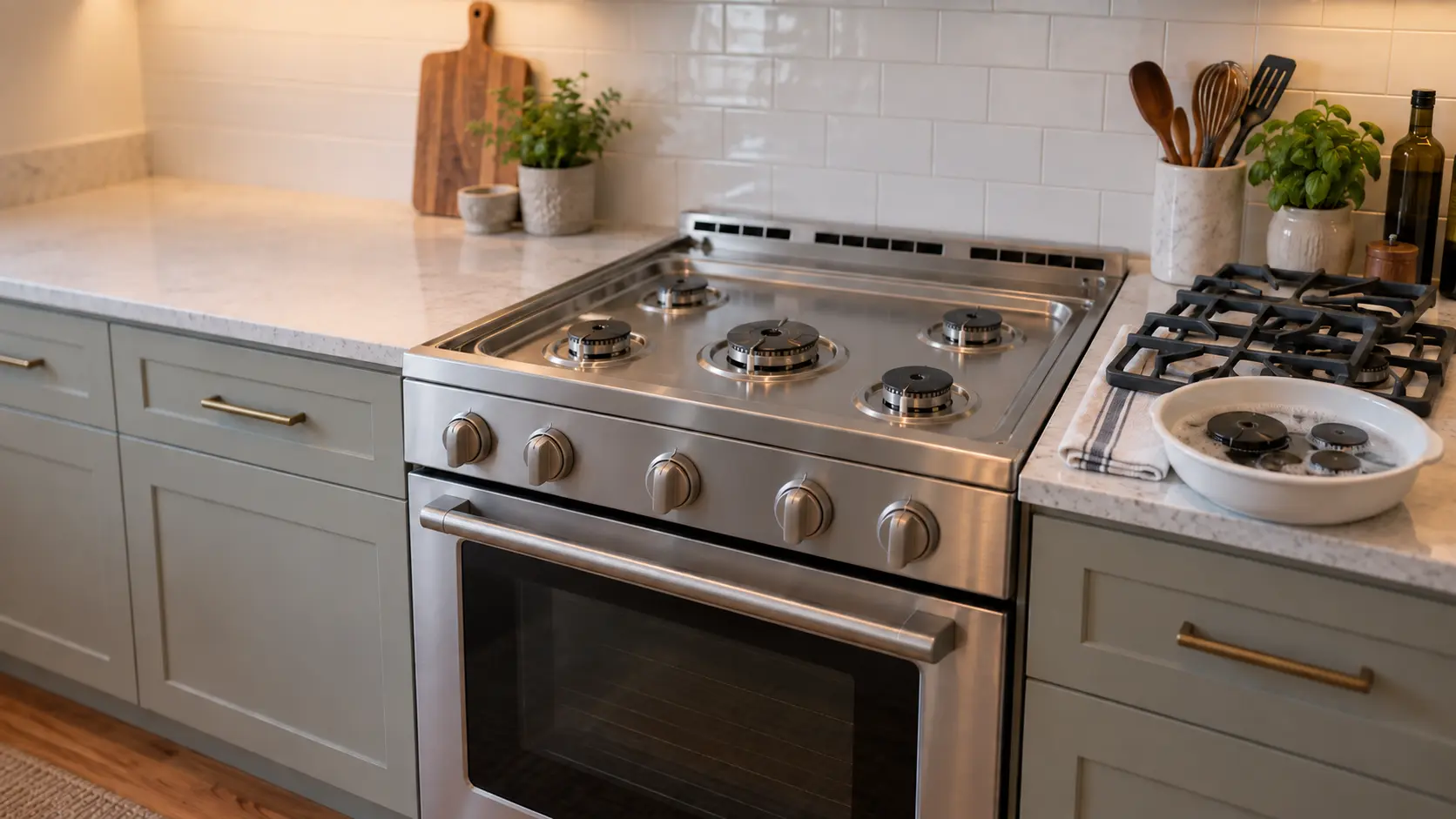
Most ranges built in recent decades have sealed burners: the cap and head lift off, and the base is fixed to the range top so spills stay above it. Some older models have open twin burners under a range top that lifts up on a hinge, with removable drip pans beneath. The cleaning is similar; the difference is how much of the spill reaches the parts below.
Source: GE Appliances — Self-cleaning gas range owner's manual and installation instructions (49-80036) — Burner openings must be kept clean for ignition and an even flame; all burners spark when one is at Lite; soak heads 20–30 minutes; clear ports with a sewing needle or twist-tie; dry heads 30 minutes in a warm oven; no dishwasher or self-clean for grates; oil cast-iron undersides; air openings are needed for combustion

Washing caps and burner heads
GE's guidance is to wash cooled caps in hot, soapy water and scrub burned-on food with a plastic scouring pad, and to soak burner heads in a mild detergent solution for 20 to 30 minutes before loosening the rest with a plastic-bristled brush or an old toothbrush. Metal pads and steel wool are ruled out for every burner part, because the fibers they shed plug the very ports you are trying to open.
Clearing blocked ports without enlarging them
Hold the head up to the light and look through each port. Any that stay dark can be cleared with a sewing needle or a wire twist-tie, pushed straight through and withdrawn, which is the method GE's manual gives. Pay special attention to the small opening in the part of the head that sits over the electrode, because the burner lights from that spot. Do not ream the ports wider or use a drill bit; a port that grows changes the flame.
Dry everything before it goes back
Shake the water out of each head and let it dry completely. GE suggests setting burner heads in a warm oven for 30 minutes, and drying caps in a warm oven or with a cloth. Water left in the ports steams and sputters, and a damp electrode area is a common reason a freshly cleaned burner clicks longer than usual.
Source: GE Appliances — Self-cleaning gas range owner's manual and installation instructions (49-80036) — Burner openings must be kept clean for ignition and an even flame; all burners spark when one is at Lite; soak heads 20–30 minutes; clear ports with a sewing needle or twist-tie; dry heads 30 minutes in a warm oven; no dishwasher or self-clean for grates; oil cast-iron undersides; air openings are needed for combustion; GE Appliances — How to clean appliances — Wash caps with hot soapy water and a plastic pad, brush heads with a plastic brush, no steel wool or metal pads on burner parts, no bleach or rust removers on grates, soap or 50/50 vinegar on porcelain, knobs off and back on at Off
Grates: soap, water and patience
Lift the grates off once they are cool and wash them in hot, soapy water, scrubbing with a plastic pad. GE advises against bleach and rust removers on grates, and its gas range manual says not to put them in a dishwasher or through the self-clean cycle; other makers write their own rules for their own grates, so follow the manual for your model rather than a general habit. Dry the grates fully before setting them back, seated securely over the burners.
Cast iron keeps its finish better with a light film of cooking oil on the underside, which GE recommends to prevent rust. Expect the tops to lose their shine over the years no matter how they are cleaned; that dulling comes from constant high heat, not from neglect. Running a burner on high for long stretches with no pan on it can also chip the finish, because nothing is there to absorb the heat.
Source: GE Appliances — Self-cleaning gas range owner's manual and installation instructions (49-80036) — Burner openings must be kept clean for ignition and an even flame; all burners spark when one is at Lite; soak heads 20–30 minutes; clear ports with a sewing needle or twist-tie; dry heads 30 minutes in a warm oven; no dishwasher or self-clean for grates; oil cast-iron undersides; air openings are needed for combustion; GE Appliances — How to clean appliances — Wash caps with hot soapy water and a plastic pad, brush heads with a plastic brush, no steel wool or metal pads on burner parts, no bleach or rust removers on grates, soap or 50/50 vinegar on porcelain, knobs off and back on at Off
The range top surface and the knobs
The surface around the burners on most gas ranges is porcelain enamel or stainless steel. GE's cleaning advice for porcelain is a soft cloth with soap and water or a half-and-half mix of vinegar and water, rinsed and dried, and no abrasive cleansers, oven cleaners or steel wool. Stainless steel takes warm soapy water or a stainless cleaner, wiped with the grain.
Knobs pull straight off their stems when they are at Off and can be washed in hot, soapy water. Put each one back at the Off position, and check that it turns and clicks the way it did before you removed it.
- Use a damp cloth, not a spray bottle, around the knob stems, so liquid does not run down behind the panel.
- Wipe around each burner base on a sealed top after every boil-over, before the spill bakes on.
- Keep the air openings at the back of the range top clear; GE's manual lists them as necessary for proper combustion.
Source: GE Appliances — Self-cleaning gas range owner's manual and installation instructions (49-80036) — Burner openings must be kept clean for ignition and an even flame; all burners spark when one is at Lite; soak heads 20–30 minutes; clear ports with a sewing needle or twist-tie; dry heads 30 minutes in a warm oven; no dishwasher or self-clean for grates; oil cast-iron undersides; air openings are needed for combustion; GE Appliances — How to clean appliances — Wash caps with hot soapy water and a plastic pad, brush heads with a plastic brush, no steel wool or metal pads on burner parts, no bleach or rust removers on grates, soap or 50/50 vinegar on porcelain, knobs off and back on at Off