Where the heat comes from in a range oven
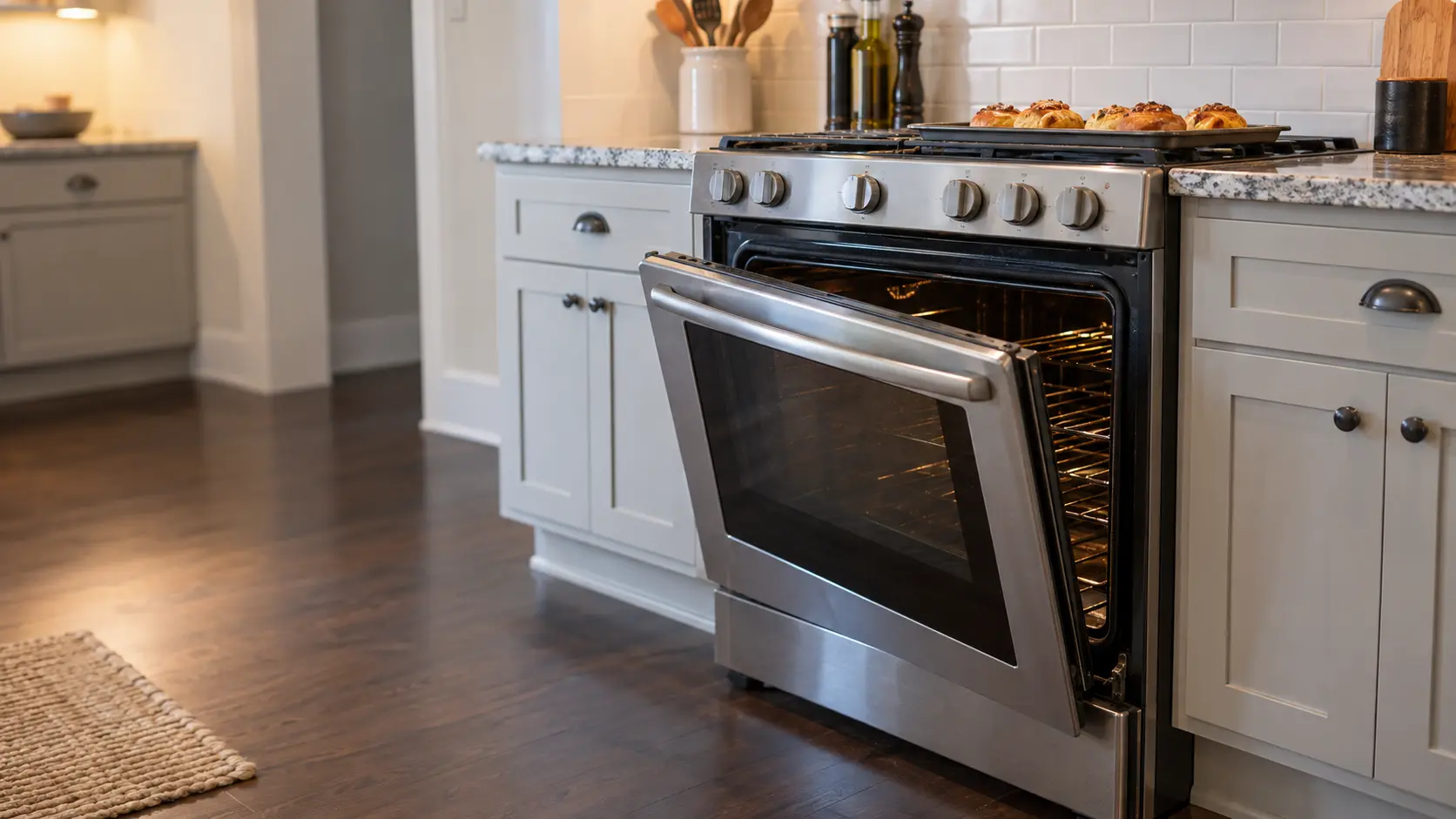
In a gas range the bake burner runs under a removable floor panel, and heat rises through slots or around the panel's edges. The broil burner sits at the top of the cavity or, on some gas ranges, in a separate drawer under the oven. In an electric or dual-fuel range the bake element is either visible on the floor or hidden beneath it, with a broil element across the ceiling.
All of these put the strongest heat low in the cavity during a bake. That is why the first sign of trouble in a range oven is so often a dark bottom crust with a pale top, or a tray that browns hard on one side where the heat enters the cavity. Knowing which design you have tells you which of the checks below matter most.
Pans, foil and the space between them
Even baking depends on hot air moving freely around the pan. Whirlpool asks for about 2 inches between pans and between a pan and the oven walls, and says not to cover a whole rack or the oven floor with foil, because it blocks that movement. Two half sheets pushed side by side on one rack behave like one solid shelf.
The pan itself matters as much as its position. Whirlpool's point is that bakeware color changes the bottom crust: a dark pan soaks up heat and browns more, while a light, shiny one reflects it and browns less. Swapping between the two without changing anything else can make a healthy oven seem to have developed a problem overnight.
- Leave a hand's width of space around the pan on every side.
- Use the pan size the recipe calls for, not the largest sheet that fits.
- Keep foil to a sheet a little larger than the dish, on the rack below it, if you need to catch drips.
- Expect a dark pan to brown faster than a shiny one at the same setting.
Foil over a gas oven floor
On a gas range the floor panel is shaped to let heat and combustion air pass from the burner below. Foil laid over it traps heat under the floor and sends it out wherever it can escape, which is usually around the edges and straight into the bottoms of pans. Removable liners sold for the purpose are covered by your owner's manual; if it does not approve one, leave the floor bare.
Source: Whirlpool — Uneven browning (range) — Allow 2 inches around pans and from the oven walls; do not cover a whole rack or the oven bottom with foil; dark pans brown more, shiny pans less; single rack by food type, center for most baking; the temperature can be adjusted after a bake test

Rack height and baking on two levels
Whirlpool's general guidance is that most baked goods do best on a single rack placed for the food: the center for cookies, layer cakes and casseroles, the top for toasting and the bottom for roasts. In a range oven the lowest positions sit very close to the bake burner or element, so a cake on the bottom rack will brown underneath long before the top is set.
When two racks are needed, space them evenly and stagger the pans so one is not directly above another. Whirlpool also notes that racks you are not using add to preheat time, so take them out before you turn the oven on.
Convection on a range
Ranges with a convection fan in the back wall even out the heat on several racks, but they can also change the number you set. On GE ranges with Auto Recipe Conversion the oven lowers the temperature by 25 degrees on its own in convection bake. If your cookies started browning differently after you switched modes, check whether the conversion is on before blaming the fan.
Source: Whirlpool — Uneven browning (range) — Allow 2 inches around pans and from the oven walls; do not cover a whole rack or the oven bottom with foil; dark pans brown more, shiny pans less; single rack by food type, center for most baking; the temperature can be adjusted after a bake test; Whirlpool — Long preheat times (range) — To 350°F: visible element about 12 to 15 minutes, hidden element about 20 minutes, each plus or minus 5; unused racks lengthen preheat; opening the door loses heat
A level range and a clear vent
A range stands on its own leveling legs, and floors in older kitchens are rarely flat. If batter in a cake pan sets thick at one side, or oil in a skillet pools against one edge, set a spirit level on an oven rack, front to back and side to side. Adjusting the legs usually means tipping or sliding the range, which involves the anti-tip bracket and, on a gas range, the connector behind it, so have that done by the installer or a technician.
The oven also breathes out through a vent at the back of the range top, which GE notes is near a rear burner on coil ranges and is the source of the steam you see while baking. Keep a big stockpot, a griddle or foil off that vent when the oven is on.
- Cake batter setting unevenly in the pan.
- Oil pooling to one side of a skillet on the burners.
- An oven door that swings open or shut on its own.
Source: GE Appliances — Frequently asked questions about ranges and wall ovens — Gas and hidden-element ovens preheat in 15 to 20 minutes; Auto Recipe Conversion sets convection 25 degrees lower; the oven vent sits near a rear burner on coil ranges; a new oven's thermostat is set at the factory and often more accurate than the old one
A new range, or an old one that changed
GE points out that a new oven's thermostat is set at the factory and is often more accurate than the one it replaced, so recipes tuned to an old, drifting oven can come out differently. Whirlpool says its range ovens can be recalibrated from the controls once a bake test shows it is needed. Neither fixes one hot side, but both explain a whole tray that is consistently lighter or darker.
An oven that used to bake evenly and no longer does is a different story. A bake element with a blister or a dark stretch that stays black while the rest glows, a gas bake flame that burns on one side only or looks yellow and ragged, a convection fan that no longer spins, or a door gasket that is torn or flattened all show up first as patchy browning.
What to note for the technician
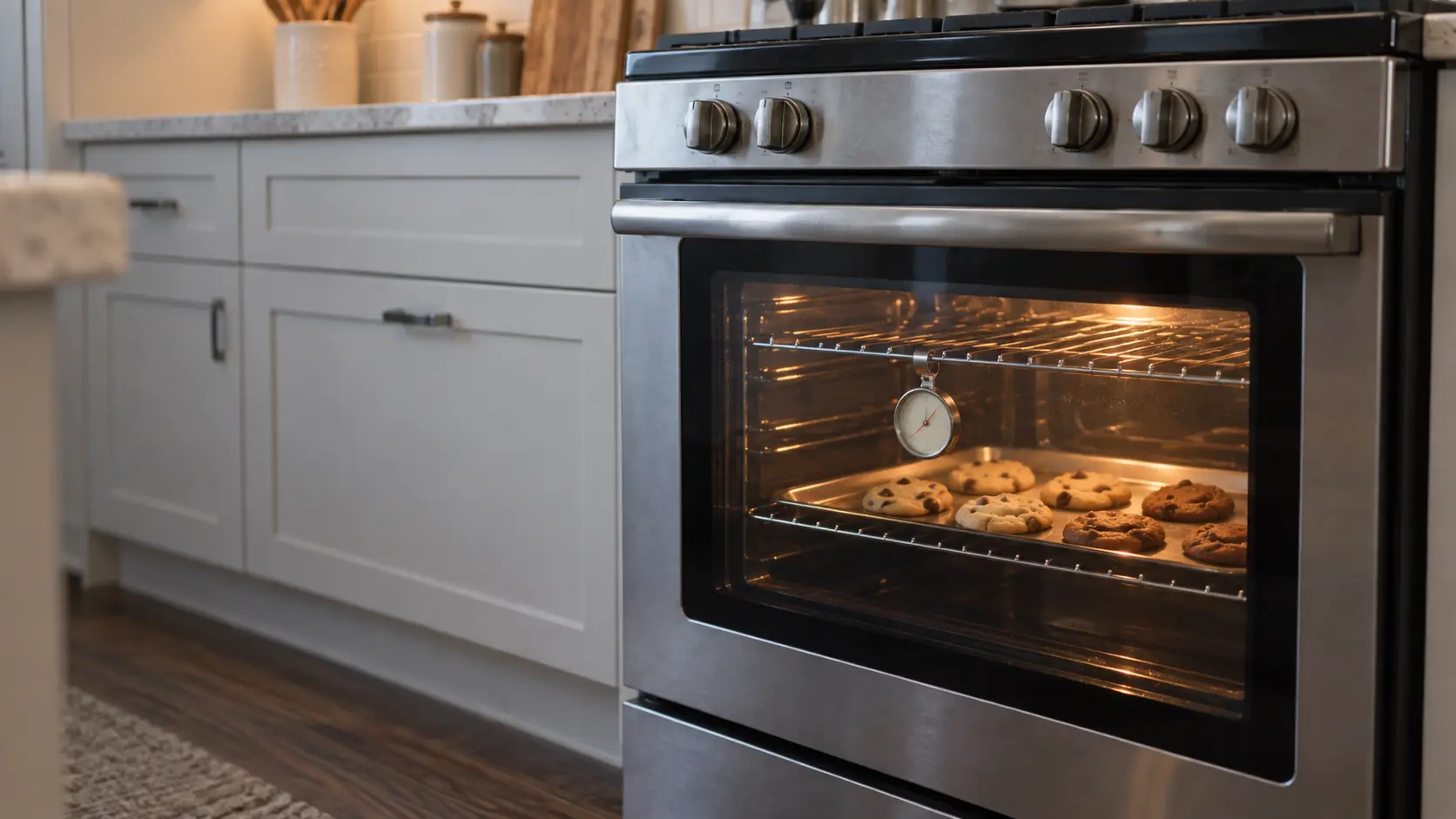
Bake one sheet of plain refrigerated biscuits or cookies on the center rack after a full preheat, and photograph the result. The pattern of browning, along with the preheat time and whether you have a gas or electric oven, tells a technician where to start before the first panel comes off.
Source: Whirlpool — Uneven browning (range) — Allow 2 inches around pans and from the oven walls; do not cover a whole rack or the oven bottom with foil; dark pans brown more, shiny pans less; single rack by food type, center for most baking; the temperature can be adjusted after a bake test; GE Appliances — Frequently asked questions about ranges and wall ovens — Gas and hidden-element ovens preheat in 15 to 20 minutes; Auto Recipe Conversion sets convection 25 degrees lower; the oven vent sits near a rear burner on coil ranges; a new oven's thermostat is set at the factory and often more accurate than the old one