
Clicking, silence or a flame that dies: sort the symptom first
Owners describe three different problems with the same words, and each one sends you to a different part of the range. Turn the knob to the lite position, keep your face back from the burner, and pay attention for a few seconds to what the range actually does before you touch anything else.
If at any point you notice a rotten-egg odor, turn the knob off and stop. The gas utilities are plain about it: leave the house with everyone in it, do not flip switches or use a phone inside, and call from a safe distance, even if the smell is faint.
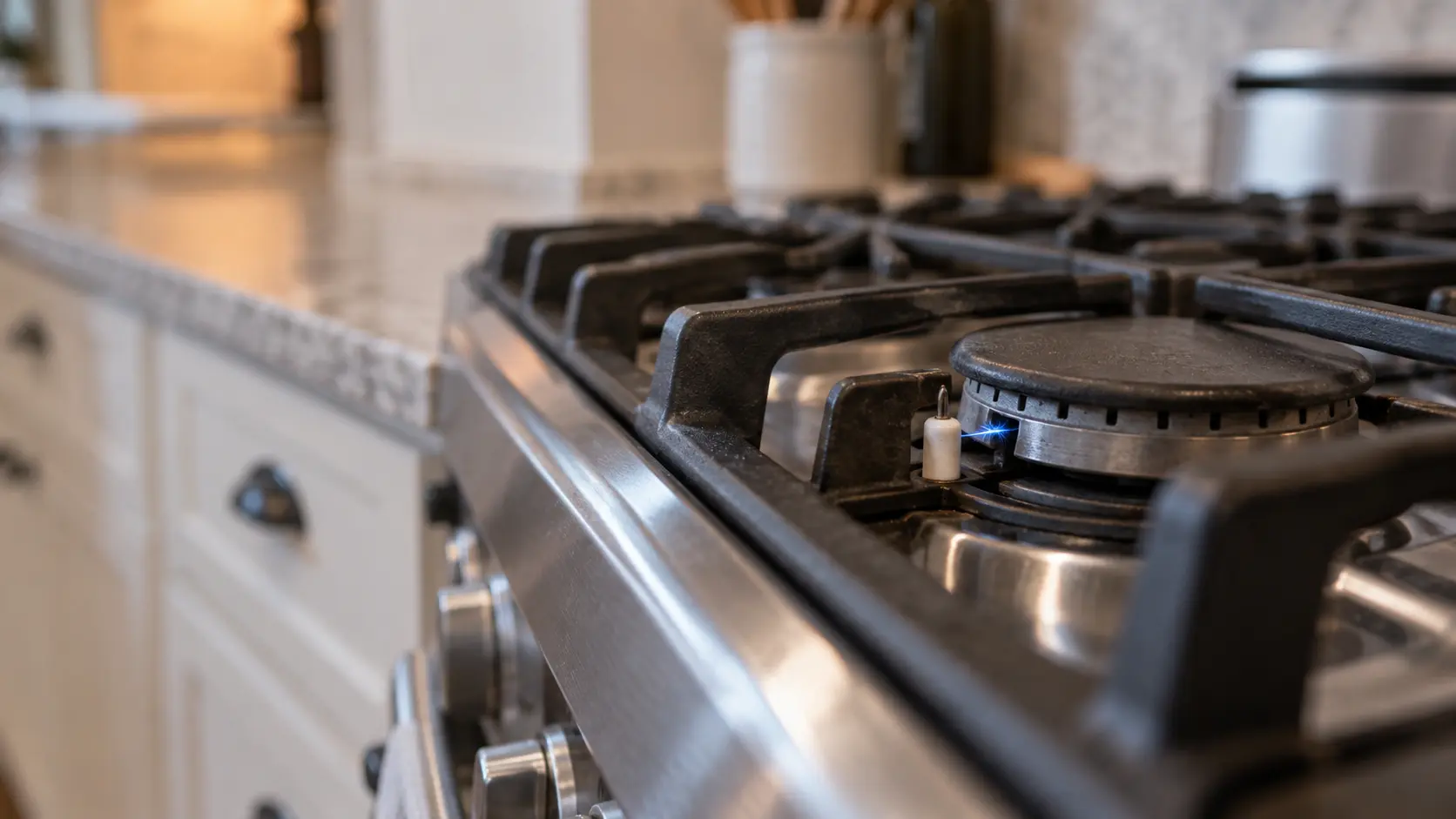
- Clicks, but no flame: the spark is there and the gas or the flame path is blocked, most often by water or food in the burner head.
- No click at any burner: the igniters have no power, so the outlet, the plug or the breaker comes first.
- Clicks at the other burners but not this one: one electrode or its wire is the likely suspect.
- Lights, then goes out when you turn the knob down: a draft, clogged ports on one side or a cap that is not flat.
Why every burner clicks when you turn one knob
On most ranges the surface igniters share one spark module, so all of them snap together while only the burner whose knob is at lite gets gas. Whirlpool and GE both describe this as normal. It also makes a useful test: if the electrode beside your problem burner is sparking along with the others, the ignition circuit is working and the trouble sits in the burner itself.
Source: GE Appliances — One or more burners are clicking — Clicking at off: turn the knob fully off so it pops back out; moisture after cleaning causes clicking, let the range dry for a few hours; several burners clicking while one lights is normal; Con Edison — Gas safety — If you smell gas, even faintly, leave immediately with others and call from away from the area; do not flip switches or use a phone nearby
Water and boil-overs, the usual culprit
Every sealed burner has a small ignition port facing the electrode, and that notch is where the first wisp of gas meets the spark. A pot of pasta that boiled over, or a wet sponge run around the burner, leaves water or starch sitting in exactly that spot. GE's support pages say the burner will keep clicking and refuse to light until the ports are clear and the burner has dried out.
Drying takes longer than most people allow. GE suggests leaving the range a few hours, or setting the removed heads and caps in a warm oven for about 30 minutes before putting them back. Whirlpool adds that cool air from a hair dryer aimed at the burner and around the knob shaft speeds it up. Try the burner again only once everything is dry to the touch, including the underside of the cap.
Spills that run down to the knob
On ranges with knobs along the front edge of the top, a boil-over can trickle toward the valve stems. The result is often an igniter that keeps ticking with the knob off. GE's first check for that is simple: turn the knob fully to off and make sure it has popped back out; if it has and the clicking continues, give the range several hours to dry before calling it a failure.
Source: GE Appliances — Common causes for slow ignition, no ignition or clicking on surface burners — Wet or dirty burners, an unseated electrode or mismatched head and cap cause no or slow ignition; dry heads and caps in air or a warm oven for 30 minutes; up to 10 or 12 clicks to ignite; press an unseated electrode down with a clockwise twist; Whirlpool — Surface burner(s) sparking or clicking — All surface burners click but only the one set to lite produces a flame; damp burners click, dry them with cool air from a hair dryer; reignition models spark to relight a flame and occasionally on low
A cap on the wrong base, or sitting crooked
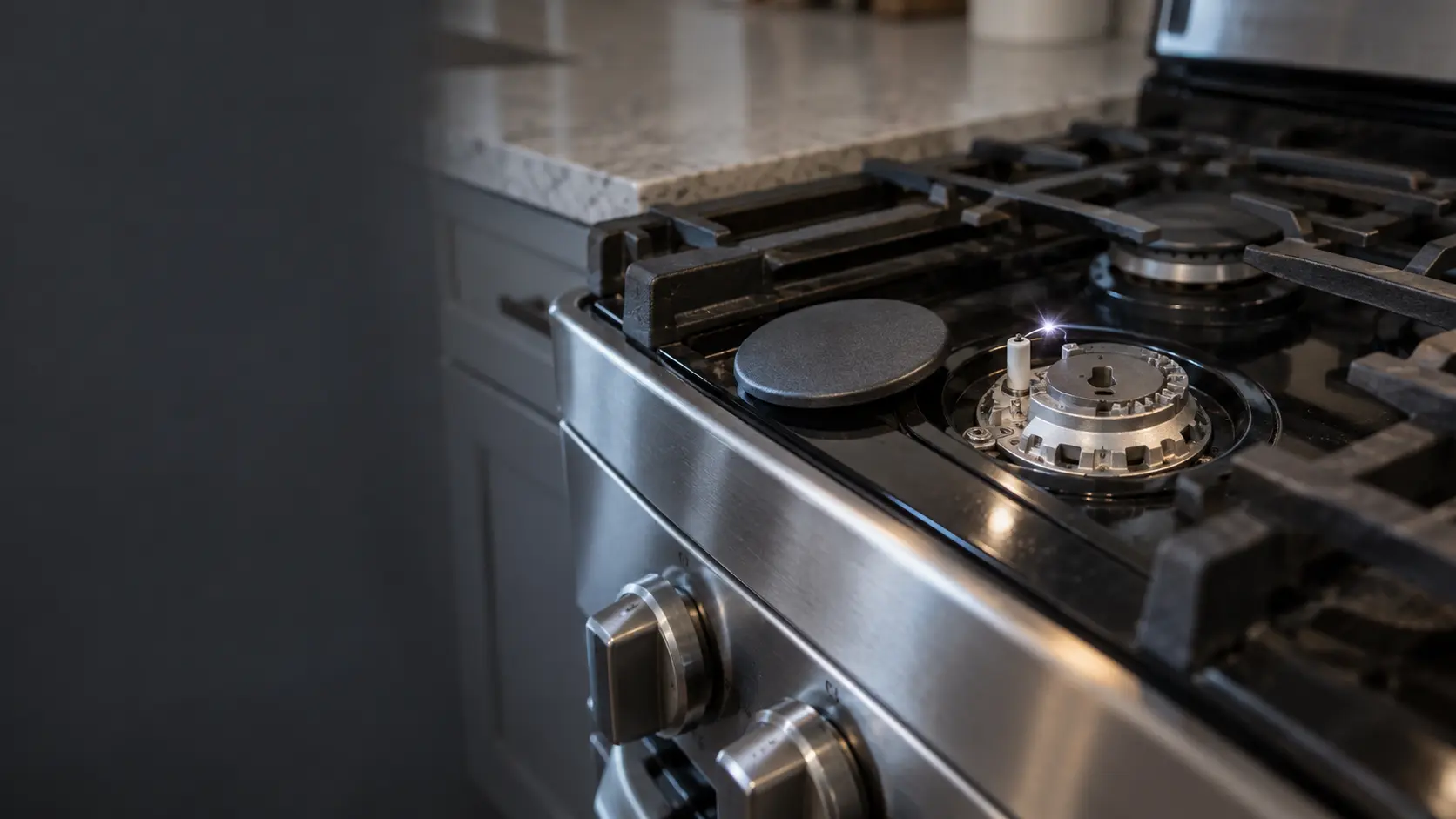
A typical gas range has three or four burner sizes, and the caps look similar enough to swap by accident after cleaning. A small cap on a medium base, or a cap resting on one of its locating pins, leaves a gap where gas escapes unevenly. The flame then lights on one side only, lifts off the burner, or never reaches the electrode at all.
Whirlpool notes that the burner base and the underside of the cap may carry a matching mark, and that a correctly placed cap sits flush with barely any side-to-side movement. GE describes the same test in plainer terms: seated properly, the cap lies flat and feels secure. Lift each cap, match it to its base, and lower it straight down rather than sliding it into place.
The white electrode beside the burner
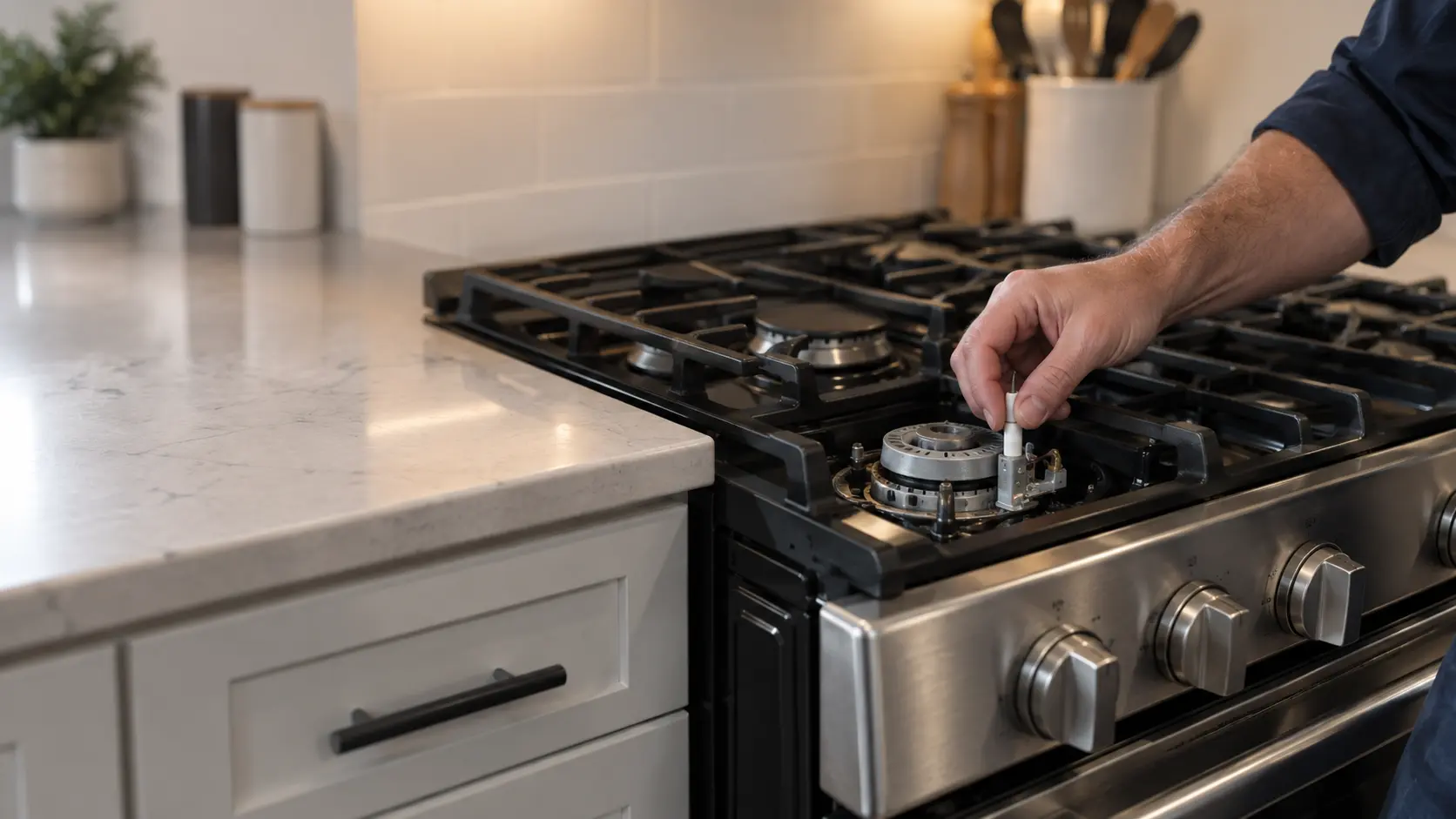
The electrode is the small white ceramic post with a metal tip next to each burner. Grease on the tip weakens the spark, and a post that has been knocked upward sits out of line with the ignition port. With the burner off and cool, GE suggests wiping the tip with a clean, dry paper towel and, if the post is not flush, pressing it down with a gentle clockwise twist. A post with a crack in the ceramic is a part to replace, not to glue.
Source: GE Appliances — Common causes for slow ignition, no ignition or clicking on surface burners — Wet or dirty burners, an unseated electrode or mismatched head and cap cause no or slow ignition; dry heads and caps in air or a warm oven for 30 minutes; up to 10 or 12 clicks to ignite; press an unseated electrode down with a clockwise twist; Whirlpool — Burner flames abnormal colors (natural gas) — Ultrasonic humidifier minerals color the flame even from another room, distilled water reduces it; cap must sit flush on its matching base with minimal movement; clear ports with a pin, needle or fine wire, never a wooden toothpick, and do not enlarge them
When nothing clicks at all
The burners burn gas, but the spark runs on household current. A freestanding or slide-in gas range plugs into an ordinary 120-volt outlet, usually reached by pulling out the storage drawer. Whirlpool asks for a grounded, working outlet with no two-prong adapter or extension cord, because the spark needs a good ground path to jump to the burner.
Test the outlet with a small appliance you know works, and look for a tripped breaker or, in an older house, a blown fuse. GE's guidance is that if the breaker is fine and no burner clicks when turned to lite, the range needs service. The spark module, the switches behind the knobs and the wiring between them sit under the range top and are for a technician.
- Does the clock or the oven light work? If so, the range has power and the problem is inside the ignition circuit.
- Was the range recently moved for cleaning? The plug can work partly loose behind the drawer.
- Did the kitchen lose power briefly? Reset the breaker for the range fully off and on.
After a new installation or a gas shutoff
When a range has just been connected, or the gas was turned off for work elsewhere in the house, the line can hold air. Whirlpool's advice is to run the surface burners so the air is pushed out, and to confirm that the shutoff valve on the pipe feeding the range is open; it is usually on the branch pipe where it comes through the wall or floor. Do not loosen any fitting to bleed the line yourself.
Source: GE Appliances — Burners won't light — No clicking: check the circuit breaker, then schedule service; wipe the electrode tip with a dry paper towel and press it down; each cap lies flat on its matching base; Whirlpool — Oven not working (gas range) — Igniters need a grounded 120-volt outlet, no two-prong adapter or extension cord; test the outlet with a small appliance; air in a newly connected line is cleared by running surface burners; the shutoff is usually on the branch pipe where it enters through the wall or floor
It lights, but the flame looks wrong
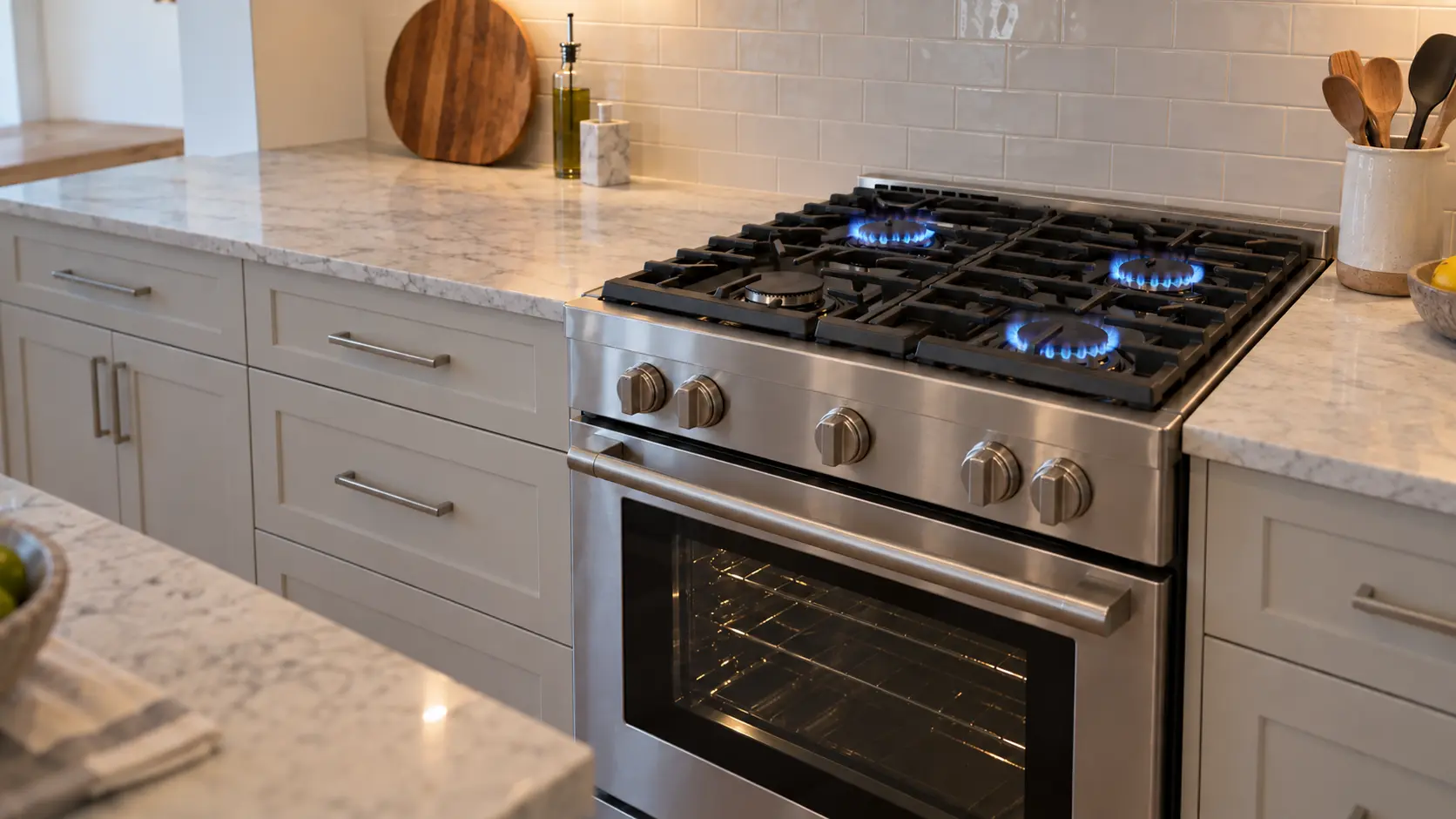
A healthy flame is an even crown of short blue cones all the way around the burner. Gaps in the ring usually mean clogged ports. Whirlpool's instruction is to clear them with a straight pin, a needle or a fine wire, never a wooden toothpick that can snap off inside, and never to widen or bend the opening.
Orange or reddish streaks can come from something as unexpected as an ultrasonic humidifier. Whirlpool explains that the mineral mist it puts into the air colors the flame even when the humidifier is in another room, and that distilled water in the humidifier reduces the effect. A flame that stays lazy and yellow on a clean, correctly capped burner, or leaves soot on the bottom of pans, is a gas-and-air adjustment and a job for a technician.
Source: Whirlpool — Burner flames abnormal colors (natural gas) — Ultrasonic humidifier minerals color the flame even from another room, distilled water reduces it; cap must sit flush on its matching base with minimal movement; clear ports with a pin, needle or fine wire, never a wooden toothpick, and do not enlarge them