An element that glows, fades and glows again
Radiant elements under a glass top are coils of ribbon wire pressed into an insulated dish. At anything below full power they work in pulses: on for a while, off for a while, with the average setting the heat. Whirlpool explains that the cycling keeps the glass itself from reaching temperatures that would damage it, so an element that goes dark during a boil is normally doing its job.
Low settings take this further. On keep warm, simmer or a warming zone, Whirlpool says the element holds its temperature without ever turning red. A saucepan of soup that is hot to the touch over a dark ring is not evidence of a failure; a pan of water that is still cold after ten minutes at high is.
Dual and triple rings that seem to be missing
Many glass-top ranges have one or two elements with a small inner ring and one or two larger rings around it, chosen with a separate switch or a second position on the knob. If only the center lights up, the zone is probably set to its smallest size. Whirlpool recommends the larger settings for wide pans, big batches and canning, and treats the single ring like an ordinary element.
Source: Whirlpool — Element(s) not working on a glass smooth top — Elements cycle on and off to protect the glass; keep warm, simmer and warming zones do not glow; control lock blocks the top and oven; reset by switching the breaker off for one minute; a 240-volt dedicated circuit
Every element cold at once
When nothing on the top warms, start with the settings, not the parts. On touch-control ranges a control lock usually blocks the elements and the oven together, and a sleeve or a damp cloth resting on the touch keys can switch it on without anyone noticing. Your owner's manual names the key to hold, often marked with a padlock.
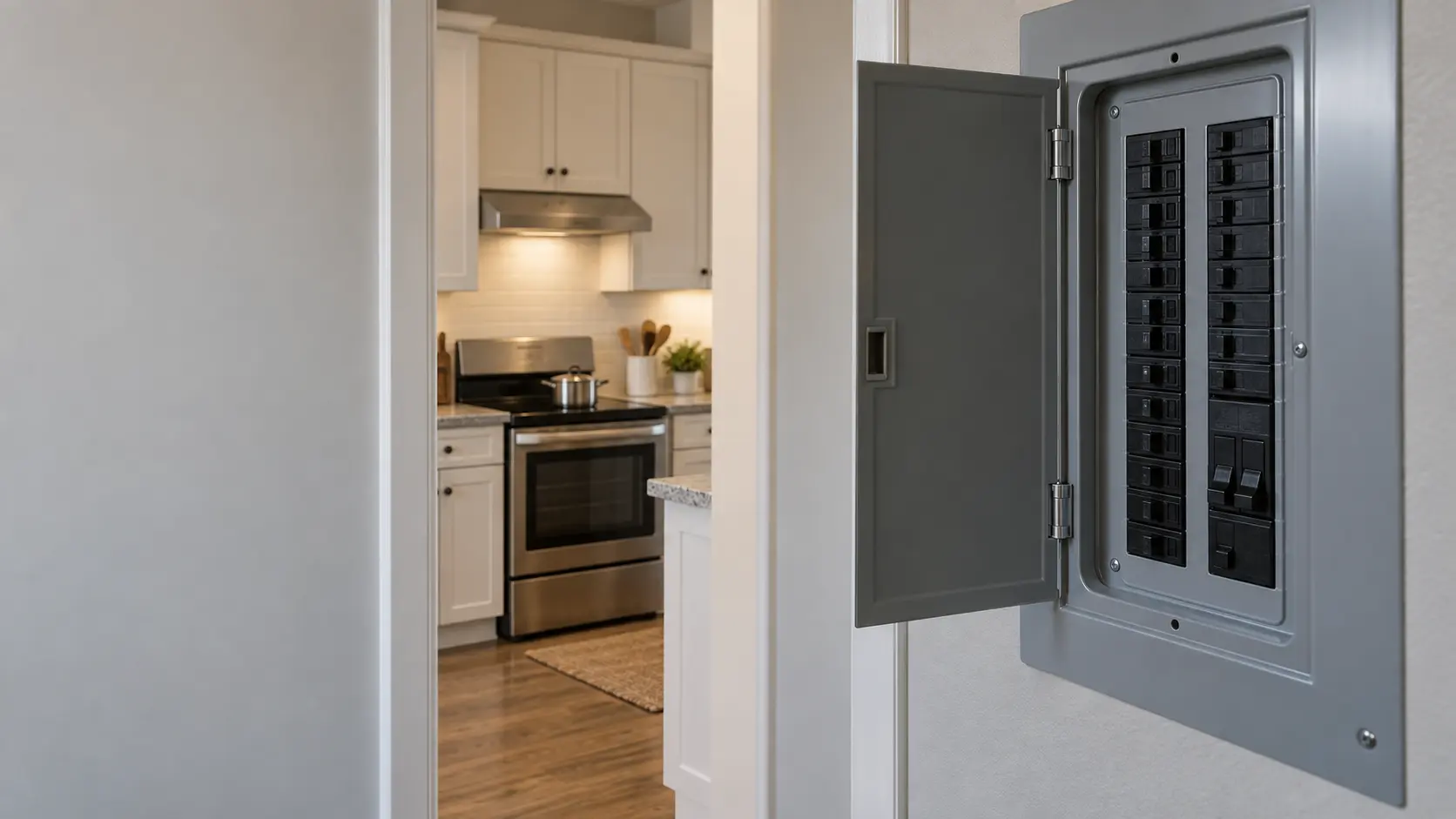
Next comes the supply. An electric range runs on a 240-volt circuit through a double breaker, and one half of that pair can trip while the clock stays lit. Whirlpool's reset is to switch the range's breaker off for one minute, switch it back on and try an element. GE adds a telling detail: when the clock works but no element heats, the power cord connection at the range may be wired wrong, which is a matter for the installer.
- Control lock or a similar locked message on the display.
- The range breaker, checked by switching it fully off and back on.
- A blown fuse, in an older house with a fuse panel.
- A range that was moved recently and may have a loose cord behind the storage drawer.
A new range whose top never worked
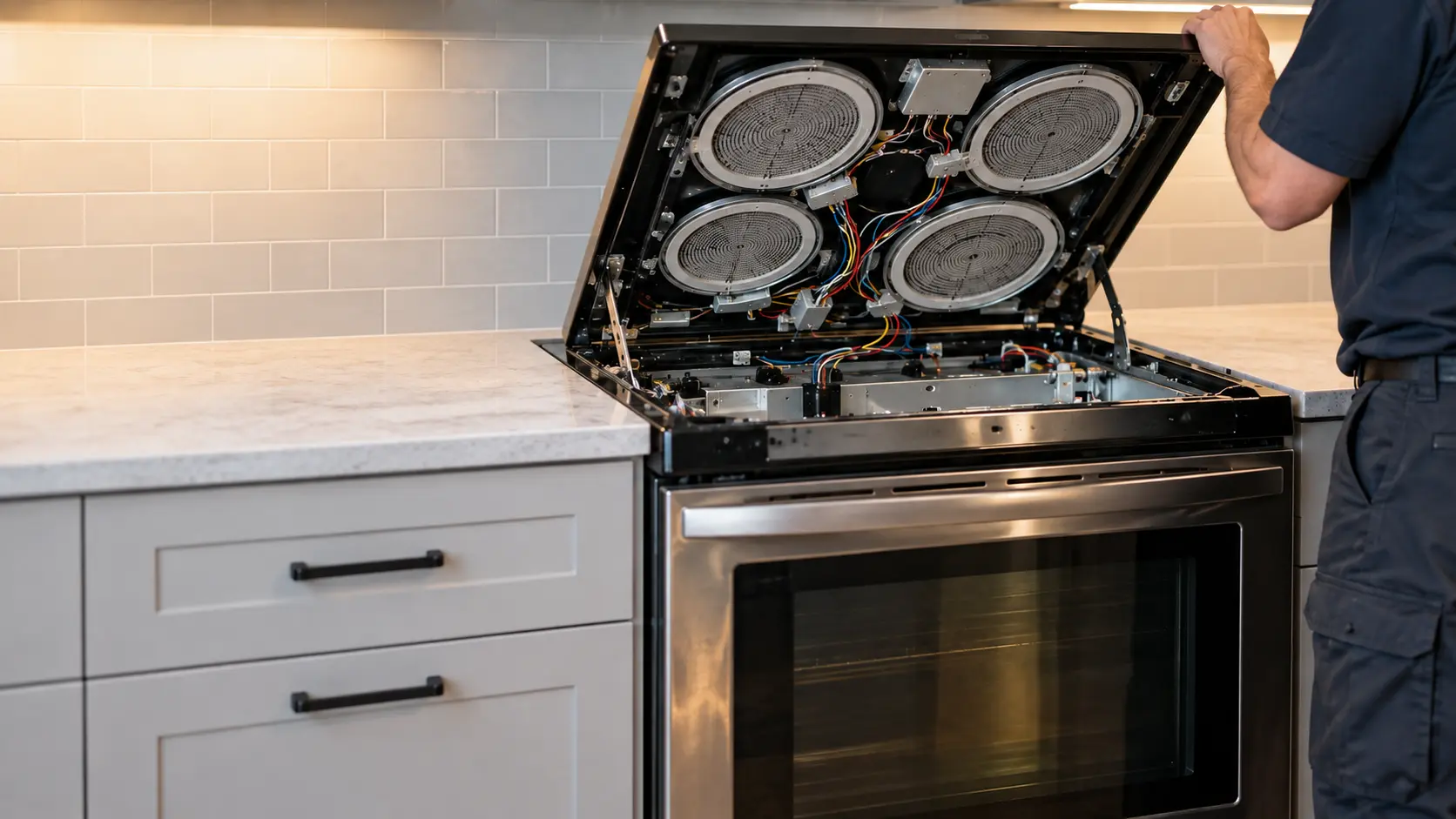
If the elements have been dead since the day of delivery, the connection is the first suspect. Whirlpool lists the points an installer should confirm: the strain relief tight on the cord, each wire on its matching terminal, and the nuts on the terminal block snug. Those sit behind a cover on the back of the range and carry full household voltage, so leave them to the installer or an electrician with the breaker off.
Source: Whirlpool — Element(s) not working on a glass smooth top — Elements cycle on and off to protect the glass; keep warm, simmer and warming zones do not glow; control lock blocks the top and oven; reset by switching the breaker off for one minute; a 240-volt dedicated circuit; GE Appliances — Frequently asked questions about ranges and wall ovens — If the clock works but the elements do not, the power cord connection may be wired improperly; swap a coil into a same-size socket to test it; use medium to heavy flat-bottom cookware, non-flat pans can crack the glass; the ON indicator follows surface limiters or stays on 30 minutes after use

One element stays dark while the others work
A glass top element not heating while the other zones work normally narrows the search to that position: the element itself, the switch behind its knob or a touch key, or the wiring between them. On a glass top none of these can be reached without lifting or removing the top, which is heavy, fragile and wired underneath.
What you can do is gather the evidence a technician needs. Try the zone at several settings, watch whether its hot-surface light comes on, and hold your palm a few inches above the glass after five minutes on high. An element that never warms at any setting, one that heats only on high, and one that will not switch off each point to different parts.
- Cold at every setting, hot-surface light off: the element or its supply.
- Heats only on high or only on low: the switch or the control for that zone.
- Stays on with the knob at off: switch off the range at the breaker and do not use it.
Coil elements are easier to test
Owners of coil-top ranges have one more check. GE's test is to move the dead coil to a working receptacle of matching size. A coil that heats in its new spot clears the coil and leaves its original receptacle or switch under suspicion, while a coil that stays cold wherever it goes has itself failed. On some models the knob must be pushed in before it turns, according to Whirlpool, and coils made since June 2018 have temperature limiters and glow less red than older ones, which is normal.
When the element heats but the food does not
A radiant element passes heat into the pan through contact with the glass. GE recommends medium to heavy cookware with a flat bottom and warns that warped or thin pans perform poorly and can even crack the glass. Lay a ruler across the bottom of the pan you use most: a gap you can see light through is enough to slow it down.
A pan much larger than the ring, or foil under the pan, spreads the same heat over more metal and less contact. Switching to the right zone size and a flat pan often turns a complaint about a weak element into a pot that boils on time.
Induction tops work differently
An induction range also has a smooth glass top but heats the pan through a magnetic field, not a glowing element, so it never turns red at all. If an induction zone will not start, the usual cause is the pan: induction works only with cookware a magnet clings to, and a zone that does not sense a suitable pan simply waits. Our page on an induction zone not detecting a pan covers that case.
Source: GE Appliances — Frequently asked questions about ranges and wall ovens — If the clock works but the elements do not, the power cord connection may be wired improperly; swap a coil into a same-size socket to test it; use medium to heavy flat-bottom cookware, non-flat pans can crack the glass; the ON indicator follows surface limiters or stays on 30 minutes after use
Reading the hot-surface light
The hot-surface indicator is useful evidence, as long as you know what it measures. GE explains that some models switch it using temperature limiters that sense the glass, while others simply keep it on for about 30 minutes after an element was last used, to give the surface time to cool.
So a light that comes on while a zone stays cold suggests the control is asking for heat that never arrives, and a light that never comes on with the knob turned suggests the request never left the switch. Neither tells you to touch the top: a cracked or chipped glass surface is a reason to switch the range off at the breaker and stop using it.
Source: GE Appliances — Frequently asked questions about ranges and wall ovens — If the clock works but the elements do not, the power cord connection may be wired improperly; swap a coil into a same-size socket to test it; use medium to heavy flat-bottom cookware, non-flat pans can crack the glass; the ON indicator follows surface limiters or stays on 30 minutes after use