
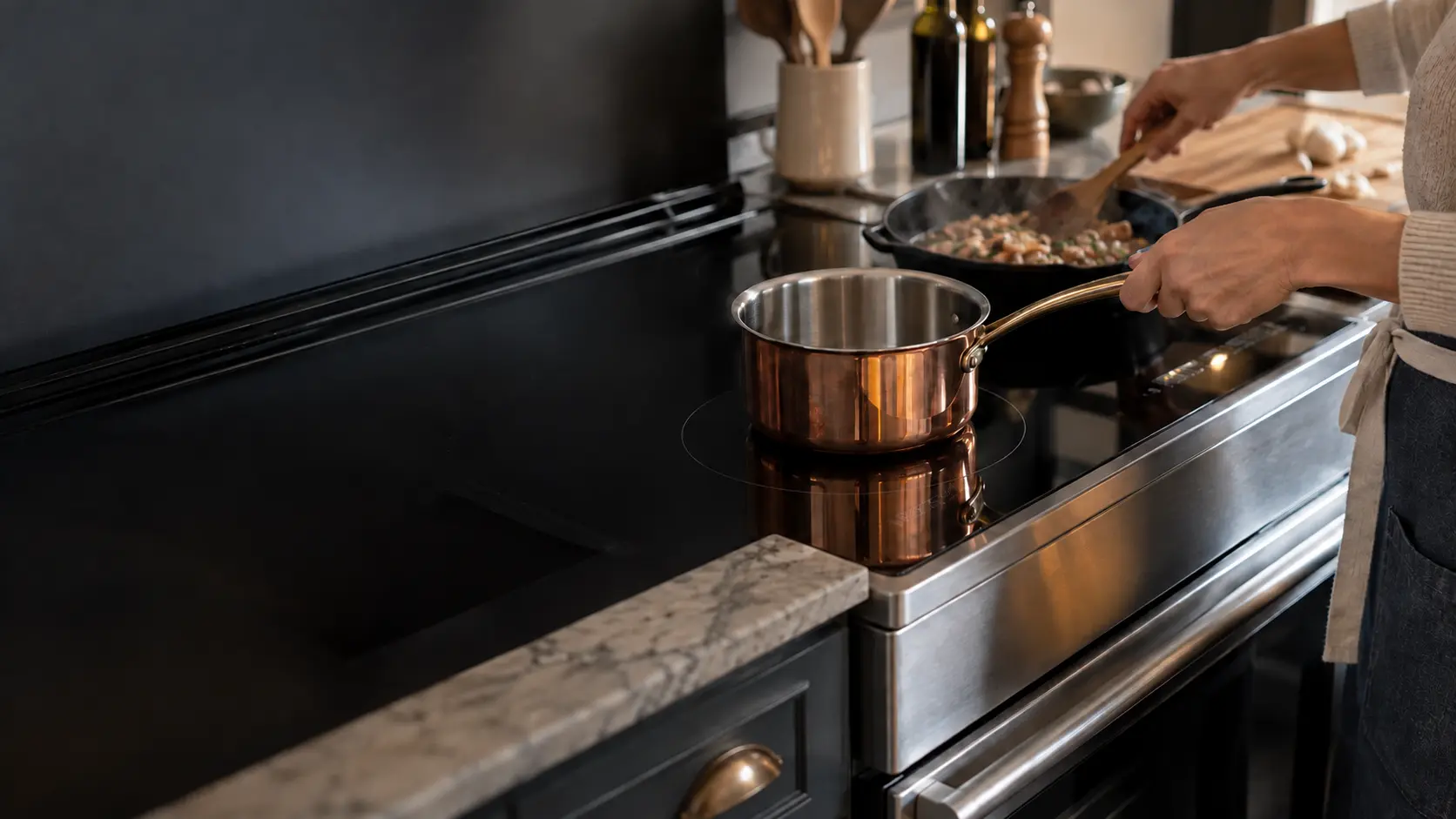

Induction Range Not Detecting Pan
An induction zone flashes, beeps, shows its no-pan symbol or switches itself off, even with a pan sitting right on it.
Mon–Sat, 8am–8pm
- 5 checks before you book
- 5 questions that narrow it
- 6 causes, cheapest first
Book a visit
Three short steps, about a minute.
or call (844) 875-7576
Loading appointment form…
The appointment form couldn’t load. Please try again.
What it
usually means.
An induction range heats the pan itself: a coil under the glass makes a rapidly changing magnetic field, and only a pan with a magnetic base turns that field into heat. The range checks for a suitable pan before it powers a zone and keeps checking while you cook. If the base is not magnetic, too small for the zone, warped or off center, the zone refuses to start and shows its no-pan signal. When a pan that has worked for years is suddenly ignored, the trouble is on the range side: the coil, its sensor, the power board that drives it, or the cooling fan that protects the electronics.
 The 6 causes, cheapest first
Answer these first
Does a kitchen magnet stick firmly to the base of the pan?
Does the pan base cover the marked ring, and does it sit flat without rocking?
Is it one zone or every zone, and do other pans work on it?
Does the range show a code, and can you hear the cooling fan run?
Does the zone start and then cut out after a short while?
Check these
before you book.
Induction range not detecting pan: 5 checks, and none of them costs anything.
Test the pan with a magnet; if it does not grip the base firmly, try a pan made for induction.
Center a flat pan that covers the marked ring and try the zone again.
Move a pan you trust to another zone to see whether the problem follows the pan or stays with the zone.
Also worth checking
- Wipe the glass and the touch keys dry, and check that the controls are not locked.
- Note any code and whether the cooling fan runs, and share both when you book.
How soon does it need a visit?
An induction zone that will not start is not an emergency. Keep cooking on the zones that work with suitable pans. If the glass is cracked, or the range smells of burning or trips the breaker, switch it off at the breaker and stop using it.
The causes,
cheapest first.
6 things induction range not detecting pan turns out to be, from pan not suited to induction to power board not driving the zone.
The cost guide-
01 no repair
Pan not suited to induction
Aluminum, copper, glass and some stainless pans have no magnetic base, so the range cannot see them. A magnet that grips the base firmly is the quick test.
-
02 no repair
Pan too small or warped
A small pan on a large zone, or a base that rocks, may not be detected at all or may make the zone cut in and out.
-
03 no repair
Control lock or water on the touch area
A control lock, or spilled water pooling on the touch keys, can make the range ignore input or cancel a zone. Drying the glass and unlocking the controls brings it back.
-
04 low
Electronics too hot to run
A fan under the top cools the induction electronics. A fan that has stopped, or vents blocked by something stored against them, makes the range shut zones off to protect itself.
-
05 moderate
Failed induction coil or its sensor
Each zone has a coil and a temperature sensor under the glass. A damaged coil or sensor can stop the zone from recognizing any pan.
-
06 moderate to highest
Power board not driving the zone
The power board turns the household supply into the high-frequency current the coils need. When a section of it fails, one or two zones go dead and show the no-pan signal.
What else
it could be.
Most often confused with range error code, then range glass top cracked.
All problems

The makes
it happens on.
32 makes on this site; induction range not detecting pan can show up on any of them. Each mark opens that make's own page.
All 32 brandsInduction Range Not Detecting Pan,
where we come out.
9 metros, each with its own page.
All service areasTampa BayFL · 31 areas
Miami / South FloridaFL · 47 areas
New York MetroNY · 75 areas
HoustonTX · 36 areas
ChicagoIL · 50 areas
Los AngelesCA · 95 areas
San DiegoCA · 31 areas

Questions about
induction range not detecting pan.
My pans say stainless steel. Why do they not work?
Why does the range hum or buzz with some pans?
Can I use a converter disk on my induction range?
Is an induction repair usually worth it?
Back to your everyday
Still seeing induction range not detecting pan?
Book with what you checked above — 5 answers save the technician the first part of the visit.