

Three ways to put heat into a pan
All three kinds of range bake the same way in the oven below, more or less; the real difference is on top. Each one moves energy into the cookware by a different route, and that route explains nearly everything else in this guide, from cleaning to the circuit breaker.
An open flame
A gas burner mixes fuel with air and burns it in a ring of small ports under the pan. You see the heat level instantly and it changes the moment the knob turns, which is why many cooks like it for searing and stir-frying. Much of the flame's heat, though, rolls up the sides of the pan and into the room.
A glowing element
A conventional electric range heats a resistance element, either an exposed coil or a ribbon under a smooth glass top, and that element passes its heat to the pan by contact and radiation. It is steady and even once up to temperature, but slow to respond: the element and the glass stay hot for a while after the knob is turned down.
A magnetic field
An induction range runs current through a copper coil beneath the glass, and the magnetic field it creates heats a compatible pan from inside its own base. The glass is warmed only by the hot pan resting on it. Response is as quick as gas, and with no pan in place the zone simply does not heat.
How much of the heat reaches the food
ENERGY STAR estimates that an induction surface transfers about 85% of its energy into the cookware, against roughly 75 to 80% for a resistance element and around 32% for a gas burner. Its consumer guidance adds that boiling water on induction takes less than half the time it takes on gas or conventional electric.
The lost heat does not vanish; it warms the kitchen. On a summer evening that means the air conditioning works against the burners, and in a small apartment kitchen the difference in comfort is easy to feel. What each fuel costs to run depends on local gas and electricity rates, so compare your own utility bills rather than a national average before you choose a gas or induction range on running cost alone.
Source: ENERGY STAR — Residential induction cooking tops (Emerging Technology Award) — Induction transfers energy at about 85% efficiency against about 32% for gas and 75–80% for resistance heating, and the surface stays cool because the pan is the heat source; ENERGY STAR — 5 reasons to switch from gas to certified electric cooking — Induction boils water in less than half the time of gas or conventional electric; most electric ranges need a 240-volt outlet; a pan a magnet sticks to is most likely induction-compatible

What each one needs behind it
The range you pick has to match the supply already in the wall, or the house has to change to match the range. This is where most comparisons made in a showroom fall short.
- Gas: a gas supply with its own shutoff valve behind the range, plus an ordinary grounded outlet for the igniters, clock and oven light; GE's gas range manual specifies a 120-volt circuit protected at 15 or 20 amps.
- Conventional electric: a 240-volt range circuit and receptacle or a hardwired connection, as ENERGY STAR notes for most electric ranges; no gas line is needed at all.
- Induction: the same kind of 240-volt circuit, sized to the amperage printed in that model's installation instructions, which can be higher than an older coil range was given.
- Any change of fuel: a qualified gas installer to run or cap a line, or an electrician to bring a heavy circuit to a spot that only had a small outlet.
Source: ENERGY STAR — 5 reasons to switch from gas to certified electric cooking — Induction boils water in less than half the time of gas or conventional electric; most electric ranges need a 240-volt outlet; a pan a magnet sticks to is most likely induction-compatible; GE Appliances — Self-cleaning gas range owner's manual and installation instructions (49-80036) — A gas range plugs into a grounded 120-volt circuit protected at 15 or 20 amps; surface burners can be lit with a match in a power failure; properly adjusted burners show a bluish rather than a yellow flame
Air, flame and hot glass
EPA lists gas cooking among the main indoor sources of nitrogen dioxide, notes that homes with gas cooking often have higher indoor levels than the air outside, and recommends an exhaust fan vented to the outdoors over the burners, along with keeping gas appliances correctly adjusted. A flame burning yellow rather than blue is a sign of poor adjustment and worth a service call on its own.
Electric ranges burn nothing, so they add no combustion gases to the room, but a coil or radiant zone stays hot enough to burn a hand for some time after it is switched off, and most smooth tops show a hot-surface light until it cools. On induction, the glass under the pan can still be hot from the pan itself, even though the rest of the surface stays cool.
When the power goes out
Electric and induction ranges stop with the power. A gas range can often keep its surface burners in use: GE's gas range manual explains lighting a burner with a match during an outage, while noting that burners already lit keep working. The oven on most modern gas ranges still needs electricity for its igniter and controls, so check your own manual before counting on it.
Source: EPA — Nitrogen dioxide's impact on indoor air quality — Gas cooking is an indoor source of nitrogen dioxide, indoor levels in such homes often exceed outdoor levels, and an exhaust fan vented outdoors over gas burners reduces exposure; GE Appliances — Self-cleaning gas range owner's manual and installation instructions (49-80036) — A gas range plugs into a grounded 120-volt circuit protected at 15 or 20 amps; surface burners can be lit with a match in a power failure; properly adjusted burners show a bluish rather than a yellow flame
Pans, cleaning and the repairs each kind tends to need
Day-to-day ownership differs as much as the cooking does. Gas grates lift off and need scrubbing; a smooth glass top wipes clean but punishes a dragged pan or a sugary boil-over; induction needs magnetic cookware, and ENERGY STAR's simple test is whether a magnet sticks to the base.
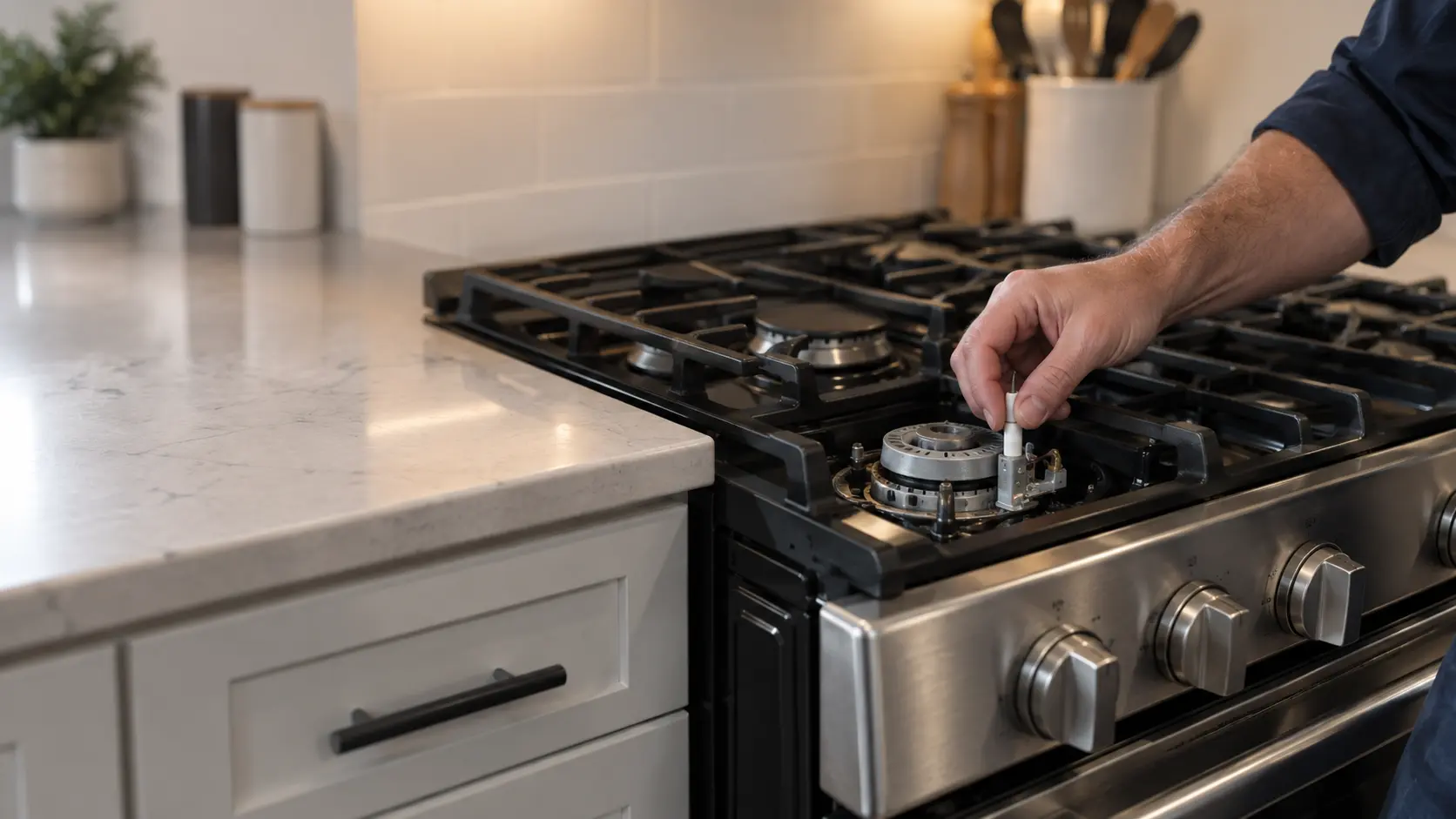
- Gas: grates, caps and burner heads lift off for washing, and a boil-over can block the small ports that both the flame and the spark depend on.
- Coil electric: drip bowls under each coil to wipe or renew, and plug-in elements that come out so the area around them can be cleaned.
- Radiant glass: a ceramic cleaning cream after use, a razor scraper for burned-on residue, and pans lifted rather than slid across the surface.
- Induction: the same glass care, plus flat magnetic pans wide enough for each zone to recognize.
| Kind of range | Common range-top repairs | What owners notice first |
|---|---|---|
| Gas | Spark electrode, spark switch, clogged burner head | Constant clicking, or a burner that will not catch |
| Coil electric | Plug-in element, receptacle, infinite switch | One coil stays cold or runs only on high |
| Radiant glass top | Element under the glass, limiter, cracked glass | A zone that glows weakly or a chip at the edge |
| Induction | Power board, coil, cooling fan | A pan that is not detected, or an error on the display |
Source: ENERGY STAR — 5 reasons to switch from gas to certified electric cooking — Induction boils water in less than half the time of gas or conventional electric; most electric ranges need a 240-volt outlet; a pan a magnet sticks to is most likely induction-compatible


