
Two appliances sharing one frame
Every range carries a cooking surface on top and an oven below, and the two share little beyond the cabinet, the power cord or gas inlet and, on newer models, a control board. A burner that refuses to light says nothing about the health of the bake element, and a cold oven says nothing about the burners. That is why the first question is always which half failed, not how old the whole thing is.
The split also buys time: while a part is on order, most households cook on whichever half still works.
When the trouble is on the range top
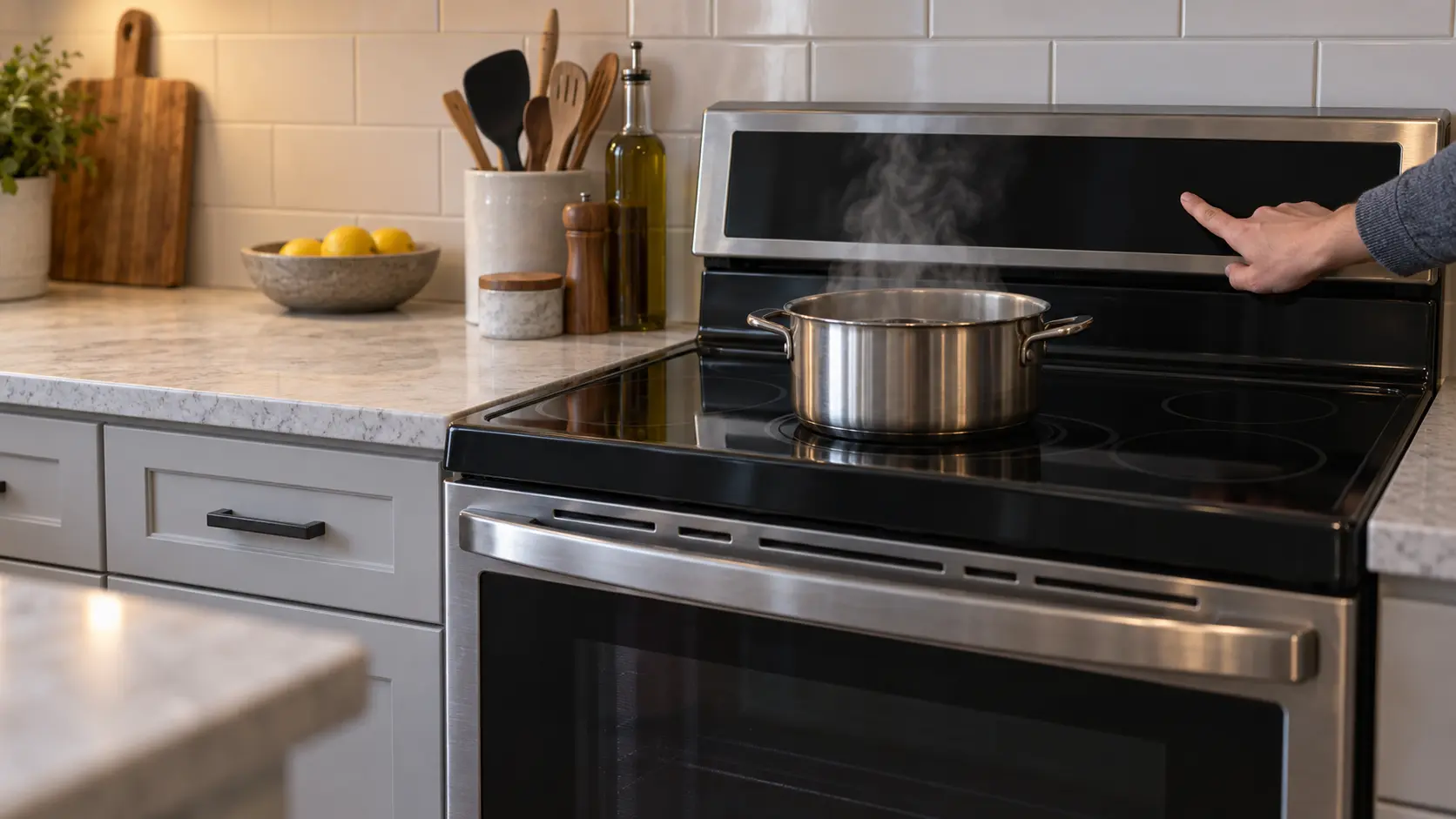
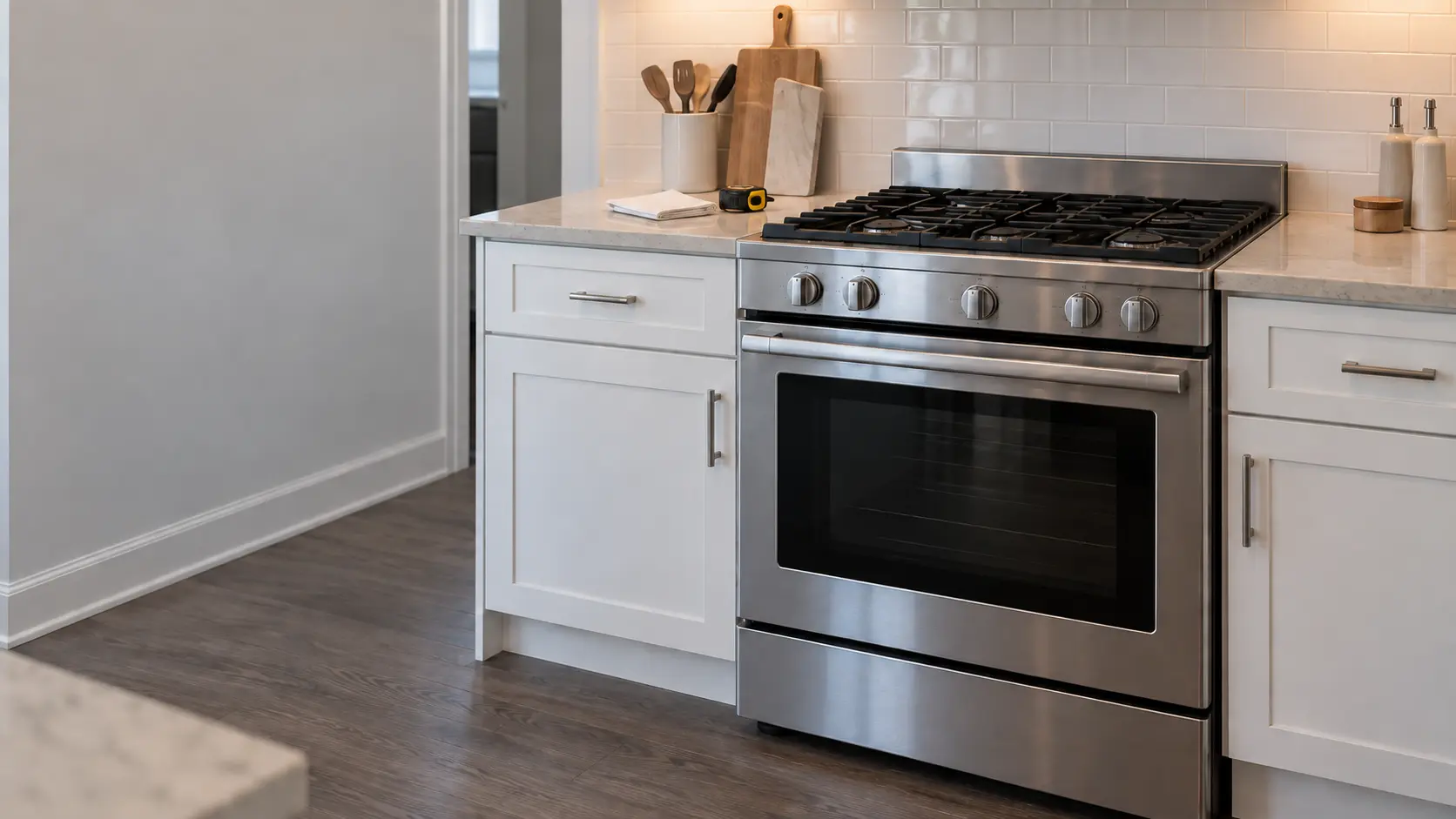
On a gas range the usual suspects are the spark electrode beside each burner, the spark switch behind the knob and the burner head itself. On an electric coil range it is the plug-in element or the receptacle it sits in. A smooth-top radiant model adds the element under the glass and its temperature limiter, and an induction range adds the coil, the power board that drives it and a cooling fan.
When the trouble is in the oven below
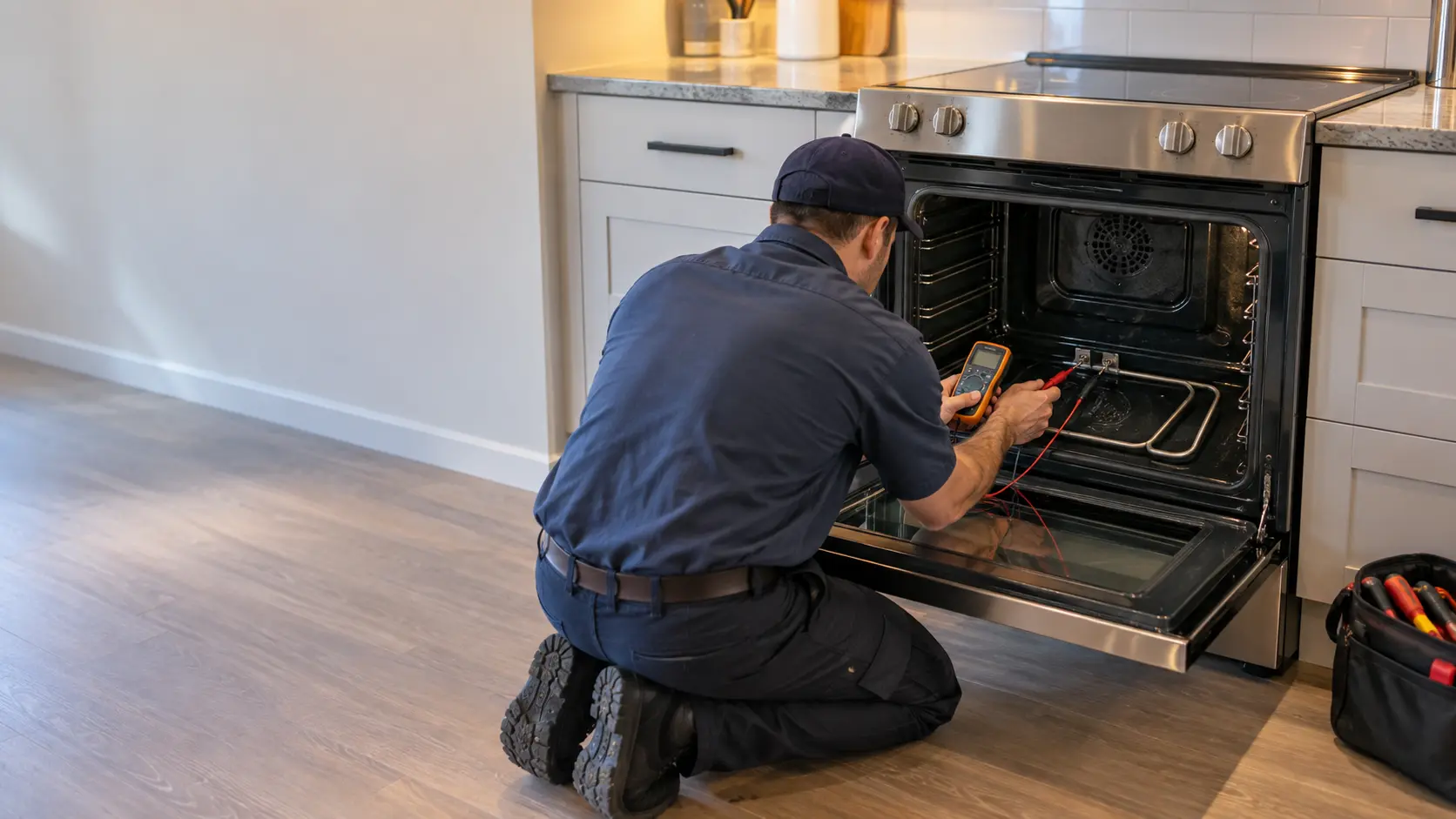
An electric oven cavity relies on a bake element, a broil element and a temperature sensor, all of which are stocked for years and reachable without moving the range. A gas oven has a glow-bar igniter that weakens with age, and a self-cleaning model adds a motorized door lock. None of these, on its own, makes a range a candidate for the curb.
Range repairs ranked from least to most
Owners tend to judge a range by how dramatic the symptom looks, but a dark oven or a silent burner is often a small bill, while a flickering panel can be a large one. Sort the failure first, starting from the lightest end:
- Nothing to replace, or the cheapest kind of repair: the breaker, a lockout, a burner cap knocked off center, Sabbath or delayed start left set, a knob slipping on its shaft.
- A single inexpensive part, the low band: a spark electrode, a spark switch, a coil element with its receptacle, a bake or broil element, the oven sensor, a pair of door hinges.
- Moderate work: a radiant element beneath the glass, the igniter in a gas oven, the door lock assembly, a convection fan motor, a relay board.
- The highest band: a new glass top, an induction power board, the main board or touch panel of a premium range, a gas valve, and any part on a model the maker no longer supports.

Findings that usually end the conversation
There is a short list of discoveries after which money spent on the old range rarely comes back. Most of them belong to ranges that have lived through years of boil-overs, long roasts and frequent cleaning cycles; GE notes that self-cleaning more often than about once a month could shorten a range's life through extra wear on components and controls.
- Rust that has eaten through the oven liner or the body panels, so the cavity no longer holds its insulation in place.
- A dead control board or touch panel that the maker has dropped from its parts list, with nothing approved to take its place.
- Burned, hardened wiring behind the rear panel, the mark of heat trapped there over many years.
- A cracked glass top on a model whose replacement top is no longer made.
- A frame bent in a tip-over, so the oven door and the range top no longer sit square.
Source: GE Appliances — Self clean oven frequency of use — Self-cleaning more often than about once a month could shorten a range's life through extra wear on components and controls
How the kind of range shifts the math
Gas, electric, induction and pro-style ranges put their expensive parts in different places, so one broken component can mean a quick visit on one kind and a hard decision on another.
| Situation | Usual answer | Main reason |
|---|---|---|
| Any range, igniter, element, sensor or hinge | Repair | A single stocked part, reached without moving the range far |
| Glass top cracked, top still sold | Usually repair | The oven and the controls are unaffected |
| Induction power board failed | Depends on age | The board is costly, and some are sold only for recent models |
| Main board discontinued | Usually replace | The range cannot be made to work without it |
| Rust through the oven body | Replace | The cavity is the structure that holds the insulation |
Gas and coil electric ranges
These are the simplest designs and the most forgiving to keep running. Igniters, spark switches, coil elements and receptacles are common parts, and many older mechanical-control models have no main board at all to become obsolete.
Glass top and induction ranges
The glass itself is the expensive part of a smooth-top range, and on induction models the power board sits close behind it. Both are worth replacing when the rest of the range is sound and the part is still listed; when either is gone from the parts catalog, the whole range usually follows.
Dual-fuel and pro-style models
A heavy range with sealed high-output burners and a large convection oven costs far more to replace than most single repairs do, and swapping it can mean new ventilation and a bigger circuit as well. Repair keeps its advantage here well past the age at which a basic range would be retired, provided the maker still lists the part.
What a new range needs from the kitchen
Standard ranges share a common 30-inch width, so the gap between the cabinets rarely forces the choice. The supply behind the range does. A gas range still needs an ordinary grounded outlet for its igniters and clock, which GE lists as a 120-volt circuit protected at 15 or 20 amps, while an electric or induction range needs a heavy 240-volt circuit. Monogram lists 25 amps for its 30-inch ranges, 30 amps for 36-inch models and 50 amps for 48-inch ones, so moving up in size can mean new wire from the panel.
Changing fuel costs more than changing models. Going from gas to induction means a new 240-volt circuit where only a small outlet stood; going the other way means a gas line run by a qualified installer. Before you repair or replace a range, add that supply work to the price tag on the new one, because the showroom never includes it.
Every new range also has to be anchored. GE's manuals warn that all ranges can tip and tell owners to install the anti-tip device packed with the range and to confirm it engages whenever the range has been pulled out from the wall.
Source: Monogram — Appliance amp size — Monogram lists 25 amps for 30-inch ranges, 30 amps for 36-inch ranges and 50 amps for 48-inch ranges; GE Appliances — Self-cleaning gas range owner's manual and installation instructions (49-80036) — A gas range plugs into a grounded 120-volt circuit protected at 15 or 20 amps; all ranges can tip, the supplied anti-tip device must be installed and checked after the range is pulled out