

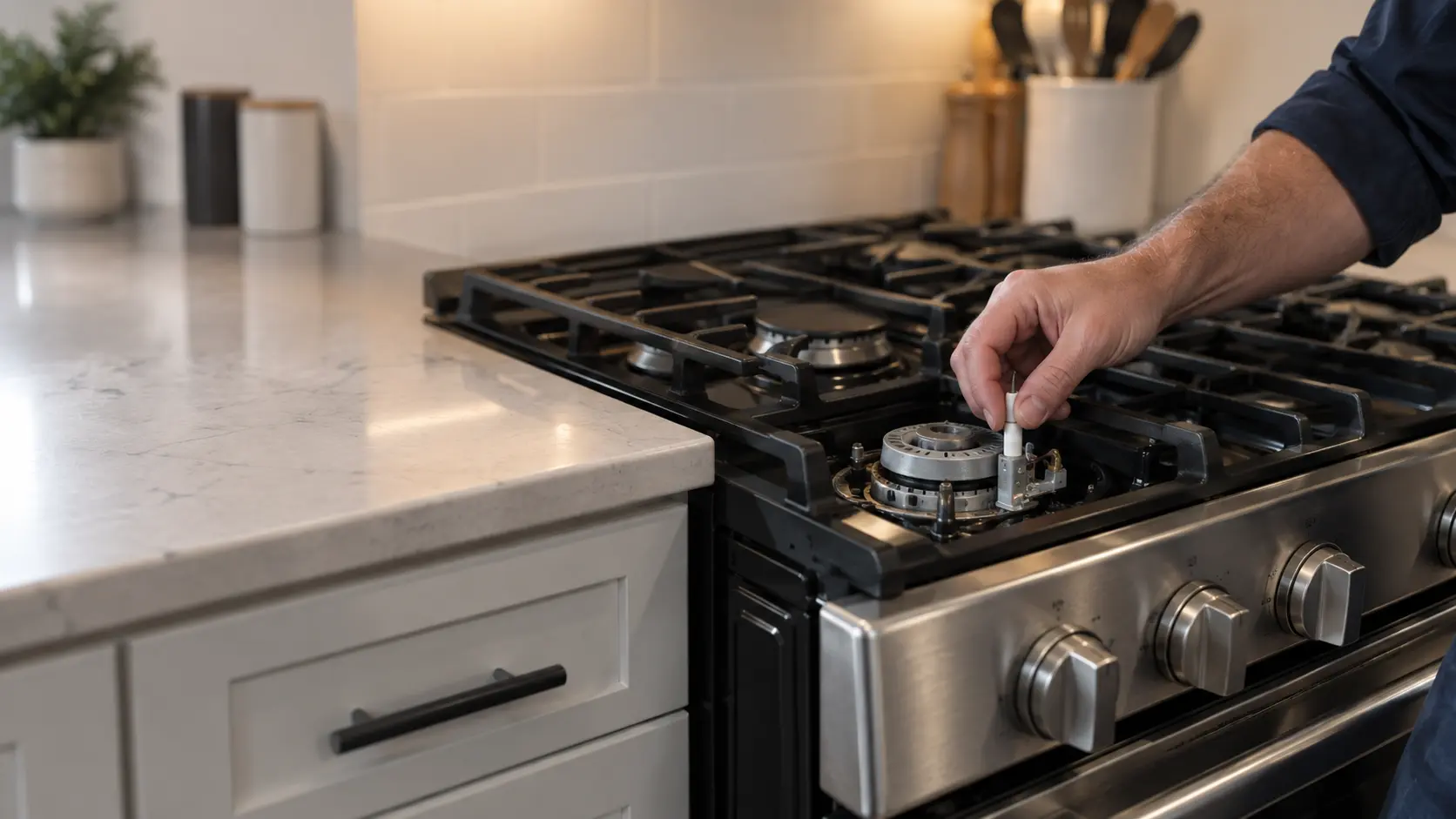
Why a natural gas range cannot just run on propane
A burner is sized for one fuel. Its orifice, the small brass jet that meters gas into the burner, is drilled for natural gas at the factory, and the regulator is set to the pressure natural gas needs. On propane, GE's conversion charts set the burners for 10 inches of water column and call for different, marked orifices. GE warns that running the burners on bottled propane before the regulator and orifices are converted can cause high flames and toxic fumes that seriously injure someone.
The rating plate decides which gases a model can use in the first place. Whirlpool puts its plate on the oven frame behind the top left side of the oven door, tells owners to check with the gas supplier if their gas is not listed, and says no conversion should be attempted without consulting the supplier. A model whose plate does not list propane is not a candidate.
Buying a range for a house on a propane tank
Whoever delivers and connects a new range in a propane home needs to know about the tank before delivery day. In the instructions we checked, the conversion parts travel with the range: GE ships its propane orifices in a small box on the back, and Whirlpool packs its orifice spuds in a cardboard holder with the literature inside the oven. That lets the conversion happen at installation instead of on a second visit.
Source: GE Appliances — Propane Conversion Instructions (31-2003392) — Running on propane before converting the regulator and orifices can cause high flames and toxic fumes; propane orifices shipped in a box on the back; regulator cap turned to the gas type; orifices marked L and color coded; oven cannot be converted by adjusting the orifice; air shutter and low flame adjustments; propane rated at 10 in. W.C.P.; yellow tips normal on propane; keep old orifices; fill in and apply the propane sticker near the regulator; Whirlpool — Installation Instructions, 30-inch Freestanding Gas Ranges (W10658550B), archived whirlpool.com copy — Factory set for natural gas; rating plate behind the top left of the oven door lists usable gases; consult the gas supplier before converting; conversions by a qualified installer; numbered, color-dotted propane orifice spuds in a cardboard holder in the literature package; keep natural gas spuds in that holder; propane inlet 11–14 in. water column; propane suppliers usually determine pipe sizes and materials
What a qualified installer changes
To convert a range to propane, the installer works from the manufacturer's own conversion sheet for that model. Power is disconnected at the breaker and the manual gas valve is closed before anything is opened, and each part is finished before the next begins. As GE and Whirlpool describe it, the job has five parts:
- The range's regulator, mounted at the rear, is switched to propane by turning over a cap or insert so the new gas type shows; the regulator itself is never removed.
- Every top burner orifice is replaced with its matching propane orifice; GE marks its propane orifices with an L and a color code, and Whirlpool stamps each spud with a number, adds a color dot and cuts a groove in the hex.
- The oven burner orifice is replaced too, because GE says its ovens cannot be converted by adjusting the orifice, and the broil burner is checked the same way.
- The oven burner's air shutter is set for propane so the flame is neither yellow nor blowing off the burner.
- Each top burner's low flame is adjusted, GE's way with the other burners running on medium, so it does not go out when the others are turned up.
Keeping the natural gas orifices
Both makers ask for the removed natural gas orifices to be kept: GE's go back in the box on the rear of the range with the instructions, and Whirlpool's into the cardboard spud holder that the propane spuds came in. Without them, a later move to a house on natural gas means ordering parts before the range can be used.
High altitude is a separate kit
GE's installation instructions add one more change above 6,000 feet: a separate high-altitude kit, one version for natural gas and one for propane, installed per its own instructions. In a mountain home, raise it when the range is ordered.
Source: GE Appliances — Propane Conversion Instructions (31-2003392) — Running on propane before converting the regulator and orifices can cause high flames and toxic fumes; propane orifices shipped in a box on the back; regulator cap turned to the gas type; orifices marked L and color coded; oven cannot be converted by adjusting the orifice; air shutter and low flame adjustments; propane rated at 10 in. W.C.P.; yellow tips normal on propane; keep old orifices; fill in and apply the propane sticker near the regulator; GE Appliances — Installation Instructions, Gas Range (31-2001181) — Factory set for natural gas; conversion by a qualified propane gas installer; orifices on the back of the range; high-altitude kit above 6,000 ft; propane inlet pressure 11–13 in. water column; Whirlpool — Installation Instructions, 30-inch Freestanding Gas Ranges (W10658550B), archived whirlpool.com copy — Factory set for natural gas; rating plate behind the top left of the oven door lists usable gases; consult the gas supplier before converting; conversions by a qualified installer; numbered, color-dotted propane orifice spuds in a cardboard holder in the literature package; keep natural gas spuds in that holder; propane inlet 11–14 in. water column; propane suppliers usually determine pipe sizes and materials

Pressure, leak testing and the first flames
The propane supply has to be within limits before any conversion can work. GE asks for an inlet pressure to the range's regulator of 11 to 13 inches of water column on propane, and Whirlpool 11 to 14. Whirlpool also notes that propane suppliers usually decide the pipe sizes and materials in a propane system, which is one more reason the supplier is part of the conversation.
Once the parts are changed, every joint the installer disturbed is leak-tested with liquid detector, then each burner is lit and watched. GE's flame chart shows some yellow tipping on the outer cones as normal for propane, where a natural gas flame should be soft blue; flames that are yellow throughout mean an air shutter or orifice still needs attention.
Source: GE Appliances — Propane Conversion Instructions (31-2003392) — Running on propane before converting the regulator and orifices can cause high flames and toxic fumes; propane orifices shipped in a box on the back; regulator cap turned to the gas type; orifices marked L and color coded; oven cannot be converted by adjusting the orifice; air shutter and low flame adjustments; propane rated at 10 in. W.C.P.; yellow tips normal on propane; keep old orifices; fill in and apply the propane sticker near the regulator; GE Appliances — Installation Instructions, Gas Range (31-2001181) — Factory set for natural gas; conversion by a qualified propane gas installer; orifices on the back of the range; high-altitude kit above 6,000 ft; propane inlet pressure 11–13 in. water column; Whirlpool — Installation Instructions, 30-inch Freestanding Gas Ranges (W10658550B), archived whirlpool.com copy — Factory set for natural gas; rating plate behind the top left of the oven door lists usable gases; consult the gas supplier before converting; conversions by a qualified installer; numbered, color-dotted propane orifice spuds in a cardboard holder in the literature package; keep natural gas spuds in that holder; propane inlet 11–14 in. water column; propane suppliers usually determine pipe sizes and materials
The sticker that tells the next person
GE's conversion instructions end with a step that is easy to skip and valuable later. Once the conversion is confirmed, the installer fills in a propane sticker with their name, organization and the date, and fixes it on the range near the regulator. Anyone who works on the range afterward then knows what gas it is set for, and the sticker comes off if the range is ever converted back.
Ask to see that sticker, or a written record, after the job. When a range in a propane home burns with tall, noisy or sooty flames, the first question is whether it was converted at all. These are the signs that it was not, or not completely:
- Tall, lazy or yellow flames on the top burners.
- Soot on the bottoms of pans or inside the oven.
- An oven burner that roars or whose flame lifts off the ports.
- Abnormal flame colors after the burner caps have been checked, which Whirlpool's own troubleshooting links to an improper conversion.
Source: GE Appliances — Propane Conversion Instructions (31-2003392) — Running on propane before converting the regulator and orifices can cause high flames and toxic fumes; propane orifices shipped in a box on the back; regulator cap turned to the gas type; orifices marked L and color coded; oven cannot be converted by adjusting the orifice; air shutter and low flame adjustments; propane rated at 10 in. W.C.P.; yellow tips normal on propane; keep old orifices; fill in and apply the propane sticker near the regulator; Whirlpool — Burner Flames Abnormal Colors, LP Gas — Abnormal flames on an LP range may mean it was converted improperly; normal LP flame is blue with slightly yellow tips
The owner's part in a propane conversion
The owner arranges the conversion and confirms it was done; the owner does not do it. Whirlpool's instructions say conversions between natural gas and propane must be done by a qualified installer, and GE's installation instructions name a qualified propane gas installer. The propane supplier or a gas appliance technician is the person to ask.
Until the conversion is finished, the range stays unused, even for a quick test of one burner. If you ever smell gas during or after the work, leave the house and call the propane supplier or 911 from outside.
Source: GE Appliances — Installation Instructions, Gas Range (31-2001181) — Factory set for natural gas; conversion by a qualified propane gas installer; orifices on the back of the range; high-altitude kit above 6,000 ft; propane inlet pressure 11–13 in. water column; Whirlpool — Installation Instructions, 30-inch Freestanding Gas Ranges (W10658550B), archived whirlpool.com copy — Factory set for natural gas; rating plate behind the top left of the oven door lists usable gases; consult the gas supplier before converting; conversions by a qualified installer; numbered, color-dotted propane orifice spuds in a cardboard holder in the literature package; keep natural gas spuds in that holder; propane inlet 11–14 in. water column; propane suppliers usually determine pipe sizes and materials


