Why the range is the last thing to touch
A range gas smell is usually noticed standing right in front of the burners, which is exactly why the urge to fix it is so strong: the knobs are within reach, and one of them might be the cause. Resist it. Nicor Gas tells its customers never to look for a leak or try to stop it themselves, and to leave straight away while avoiding anything that could make a spark.
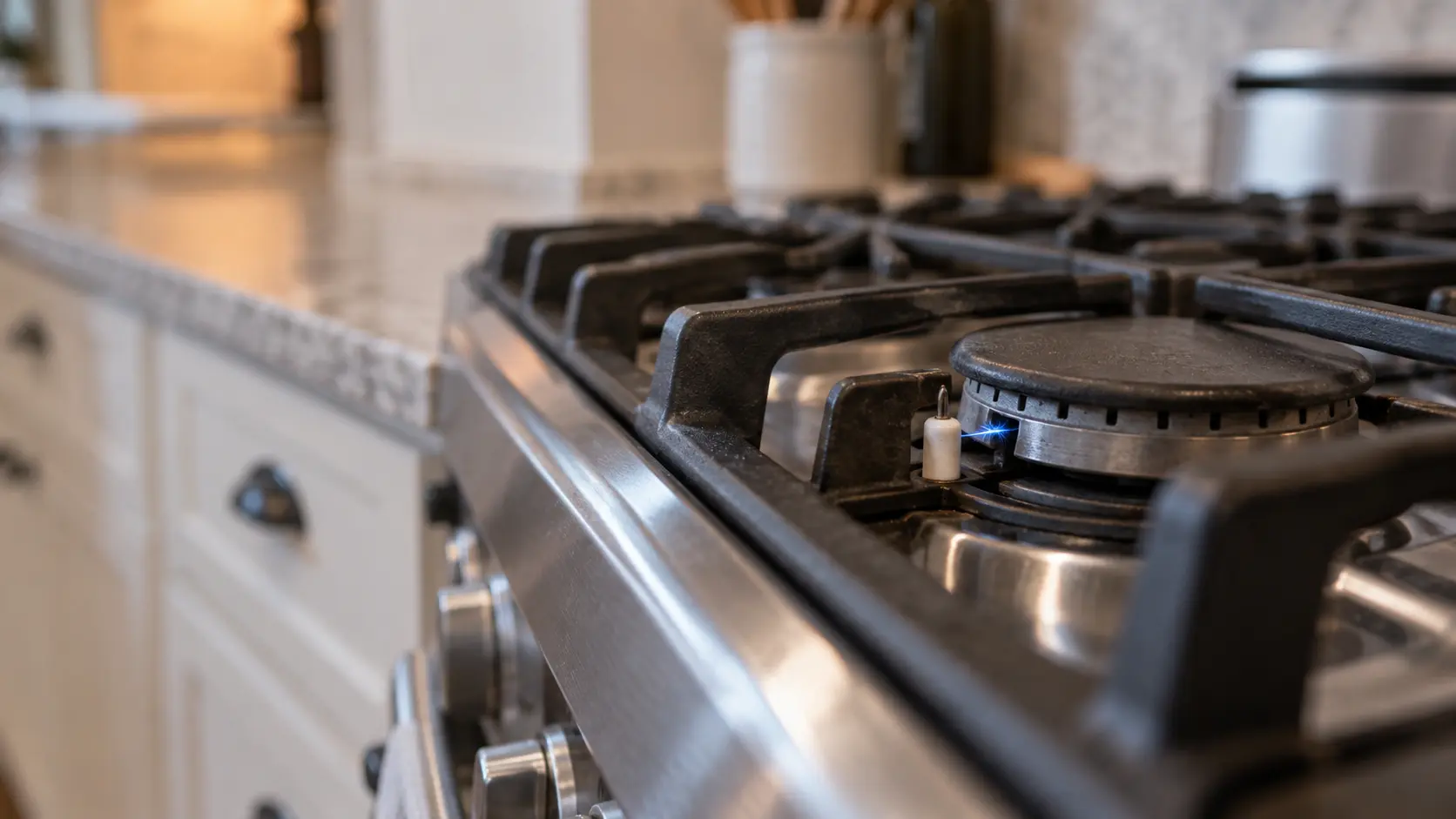
Turning a burner knob is not a harmless act on a modern gas range. The GE and Whirlpool installation instructions both describe top burners lit by an electric spark as the knob turns to its lite or ignite position, so reaching for a knob can fire the igniter into the very gas you are smelling. The same caution covers the oven controls, the hood fan above the range and every light switch on the way out.
- No burner or oven knob, not even to turn one off.
- No light switch, hood fan or countertop appliance on the way out.
- No phone call, cell or landline, until you are outside and clear of the house.
- No flashlight, lighter, match or cigarette.
- No starting a car parked in an attached garage.
A knob that looks turned on
If you can see from the doorway that a burner knob sits in an on position with no flame under the grate, that is useful to tell the utility, not a reason to walk back and turn it. Gas that has been flowing unlit for a while has already spread around the range, and your hand would be in the middle of it.
Faint, fading or gone
Nicor warns that some people cannot pick up the odorant at all, because of a reduced sense of smell, because they have been in the room long enough to stop noticing it, or because other odors cover it. Dinner on the burners is exactly that kind of cover. A smell that seems to vanish while you stand there has not stopped; your nose has, so treat it the same as a strong one.
Source: Nicor Gas — Emergency information: Smell gas? Act fast — Mercaptan gives natural gas its odor; never find or stop a leak yourself; leave and avoid ignition sources including phones, flashlights, light switches and vehicles; olfactory fatigue and masking odors; call from a safe place and stay away until told it is safe; Whirlpool — Installation Instructions, 30-inch Freestanding Gas Ranges (W10658550B), archived whirlpool.com copy — Spark ignition while the knob is at LITE; burners will not light if caps are not properly positioned; gas leaks cannot always be detected by smell; gas suppliers recommend a UL- or CSA-approved gas detector; GE Appliances — Installation Instructions, Gas Range (31-2001181) — Top burners light by spark module at the LITE position; installer informs the consumer of the gas shut-off valve location and makes sure everyone operating the range knows how to shut off the gas
Calling the utility once you are clear
Put real distance between you and the house, enough that an ignition could not reach you, then call the gas utility's emergency number and 911. Nicor's instructions put that call after you reach a safe place, and ask you to stay away until emergency personnel say it is safe to return. A crew sent to a kitchen that turns out to be fine has not been wasted; checking is the job.
The crew will want a few details, and every one of them can be given from the sidewalk:
- That the smell was in the kitchen by a gas range, and whether it seemed strongest at the burners, at the oven door or low down behind the range.
- Whether anything on the range was in use, or a burner had just been lit and gone out.
- Whether the range was delivered, moved, cleaned behind or converted to propane recently.
- Whether anybody has a headache, nausea or dizziness since the smell began.
Source: Nicor Gas — Emergency information: Smell gas? Act fast — Mercaptan gives natural gas its odor; never find or stop a leak yourself; leave and avoid ignition sources including phones, flashlights, light switches and vehicles; olfactory fatigue and masking odors; call from a safe place and stay away until told it is safe

Where gas can escape on a freestanding or slide-in range
Once gas is inside a range it travels a long way. The house pipe ends at a shutoff valve behind or below the range, a flexible connector runs to the pressure regulator on the back, and from there tubing feeds a valve behind every knob, each burner on top, and the bake and broil burners in the oven. Any joint along that path, and any burner left open without a flame, can put gas into the room.
Two of those points get disturbed more than the rest. The connector flexes whenever the range slides out, and Nicor warns that moving an appliance even slightly can make an old, weakened connector fail. The top burners are the other: Whirlpool's instructions note that a burner will not light if its cap is not seated properly, and a knob held at lite over a burner that will not catch is still releasing gas.
Soon after a delivery, a remodel or a move
A smell that starts within days of a new range arriving, a floor being replaced or someone pulling the range out to clean behind it points toward the connection at the back. That is not something to test with a bowl of soapy water and a brush. It is what the utility or a gas technician checks with proper equipment when they arrive.
Source: Nicor Gas — Appliance connectors — Moving an appliance even slightly can cause an older, weakened connector to fail; Whirlpool — Installation Instructions, 30-inch Freestanding Gas Ranges (W10658550B), archived whirlpool.com copy — Spark ignition while the knob is at LITE; burners will not light if caps are not properly positioned; gas leaks cannot always be detected by smell; gas suppliers recommend a UL- or CSA-approved gas detector
Why smell alone is not the whole alarm
Whirlpool's installation instructions for its freestanding gas ranges state plainly that gas leaks cannot always be detected by smell, and pass on the gas suppliers' recommendation of a gas detector listed by UL or CSA. That matters most for someone living alone with a weak sense of smell, or in a home where the kitchen is closed off from the bedrooms at night.
A natural gas detector and a carbon monoxide alarm are different devices. One reacts to fuel that has escaped unburned; the other reacts to what a badly burning flame gives off, which has no smell at all. A home with a gas range is better off with both, each placed according to its own instructions.
What everyone in the house should know
GE's installation instructions ask the installer to tell the household where the range's gas shutoff valve is and to make sure everyone who cooks on it knows how to close it. That knowledge is for planned work such as a repair visit or a move. During a smell the same valve sits right at the source, so the rule for children, guests and adults stays the same: out first, call second.
Source: Whirlpool — Installation Instructions, 30-inch Freestanding Gas Ranges (W10658550B), archived whirlpool.com copy — Spark ignition while the knob is at LITE; burners will not light if caps are not properly positioned; gas leaks cannot always be detected by smell; gas suppliers recommend a UL- or CSA-approved gas detector
Before the range is lit again
The utility may close the supply to the range or to the whole house and tag the valve. Restoring gas is the utility's decision, and relighting the range is the last step, not the first. If the leak was in the house piping, that repair belongs to a plumber or gas contractor; if it was at the range, the connector, regulator or a burner valve needs attention before any knob is used.
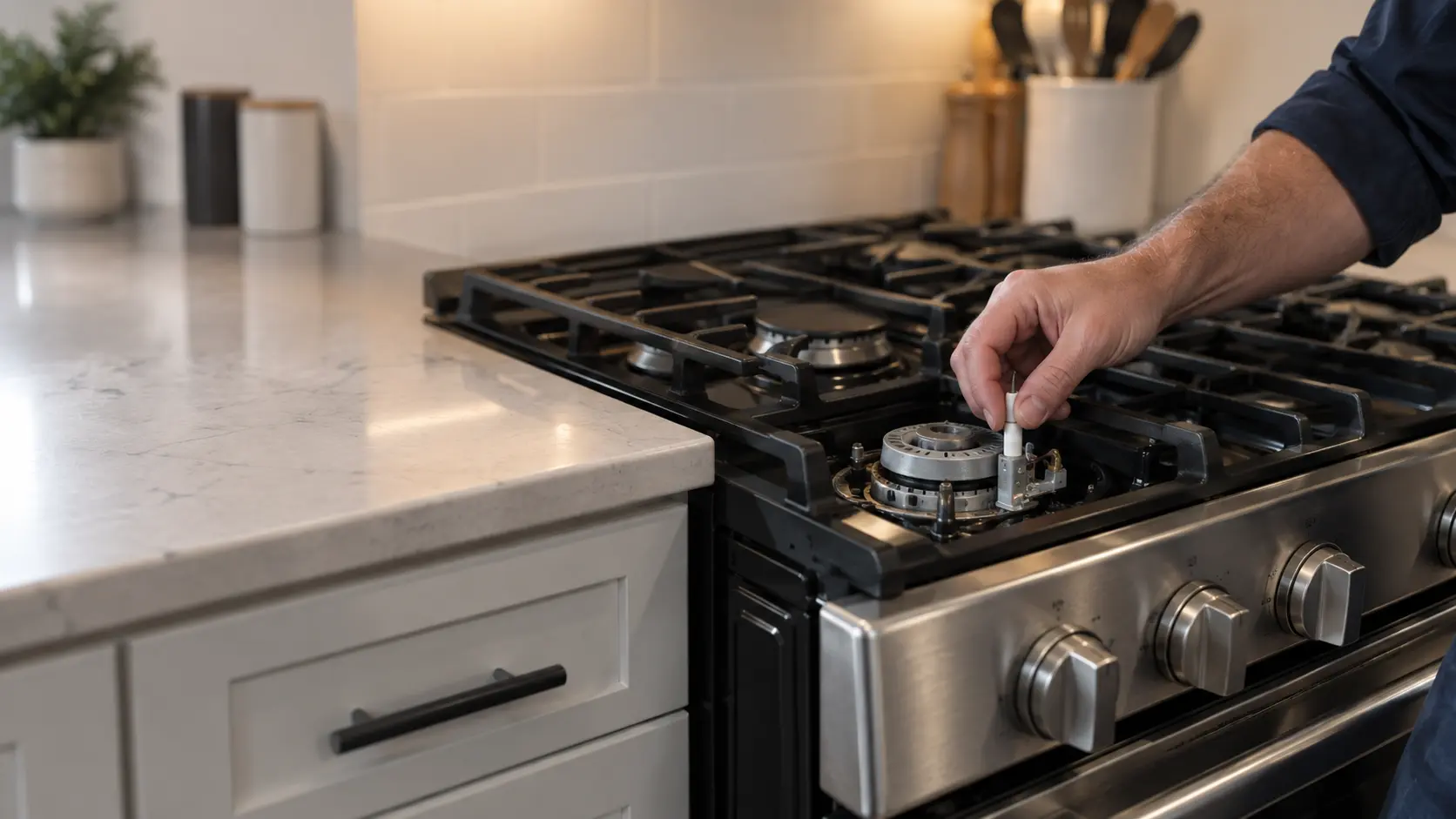
Once the utility has made the kitchen safe, a technician from our team can work on the range itself: checking that every top burner catches promptly with a steady blue flame, that the oven burner lights and stays lit, and that each valve behind the knobs closes fully.